
Petroyuan Trap Update: Fortifying the Dollar Perimeter
Swap Lines, the Petrodollar Zone, and the Consolidation of the Financial Trap
My earlier analysis, The Petroyuan Trap, identified a three-stage financial trap: a physical squeeze on energy supply, a financial mirage generated through control of oil price benchmarks, and a currency ambush targeting China’s dollar reserves. A new development—the rapid expansion of US dollar swap lines into the Persian Gulf and Asia—fits this framework precisely and suggests the operation is entering a new phase.
What Has Happened
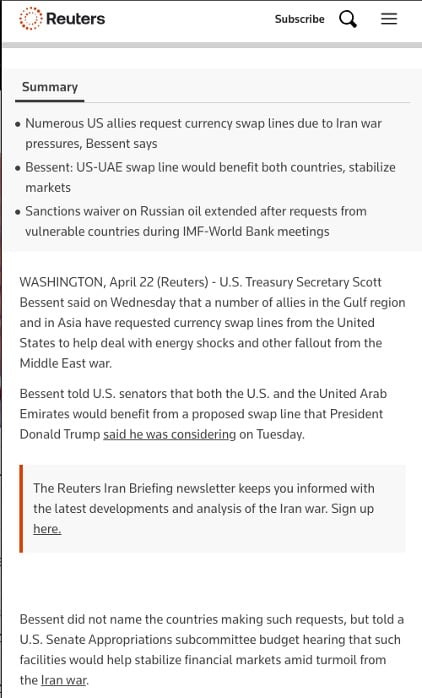
In late April 2026, according to Reuters, Treasury Secretary Scott Bessent confirmed that “many” Gulf allies and “numerous” Asian allies have formally requested dollar swap lines from the United States. The UAE is the most advanced candidate, with discussions involving both the Treasury and the Federal Reserve. This follows the precedent set in October 2025, when Bessent extended a $20 billion swap line to Argentina through the Treasury’s Exchange Stabilization Fund—bypassing the Federal Reserve entirely. That facility has since been repaid, and the administration now cites it as a template for the new arrangements now under negotiation.
Why This Matters for the Hypothesis
The swap line expansion is not a humanitarian gesture. It will structurally reinforce the dollar system exactly when the physical and financial components of the trap generate maximum pressure on China’s foreign reserves.
The logic runs as follows. The kinetic destruction of energy infrastructure documented earlier has created a global scarcity of oil and LNG. Once that scarcity is priced in, it will drive up spot prices and force energy-importing nations to expend dollar reserves at an accelerating rate to secure supply. The currency ambush I described exploits this drain by attacking the offshore yuan, widening the gap between the controlled onshore rate and the free-floating CNH, and forcing the PBOC to spend further dollars in defence. The global fallout from a global currency war between the two largest economies on Earth will likely trigger the economic chemotherapy I referred to in a previous article.
A recent article in Euro Intelligence by Wolfgang Munchau provides strong support for certain elements of this thesis suggesting the consequences of the of the Iran conflict are far greater than we see priced in markets:


What the swap lines do is consolidate the rest of the dollar system against precisely this pressure. By providing Gulf states—whose currencies are pegged to the dollar and whose oil revenues are disrupted by the Hormuz closure—with direct access to dollar liquidity, the Treasury prevents a disorderly sell-off of US assets that might otherwise result from their own reserve depletion. Bessent himself has been explicit: the purpose is “to maintain order in the dollar funding markets and to prevent the sale of US assets in a disorderly way.” In effect, the swap lines ensure that the dollar system’s periphery remains stable while the pressure is concentrated on the primary target.
The Pre-Emptive Logic
A critical feature of the current expansion is its timing. Unlike in 2008 or 2020, when swap lines were deployed reactively during acute crises, the 2026 negotiations are occurring before a full-scale dollar liquidity crisis has materialized. As one analysis noted, there is “no acute dollar shortage yet”. The moves are precautionary—designed to position the system in advance.
This is consistent with my characterization of the operation as a deliberate, multi-stage trap rather than an improvised response to events. The swap line architecture is being assembled before the currency ambush unfolds, ensuring that when the pressure on the offshore yuan intensifies, the rest of the dollar system has already been reinforced against contagion.
The Bessent Doctrine
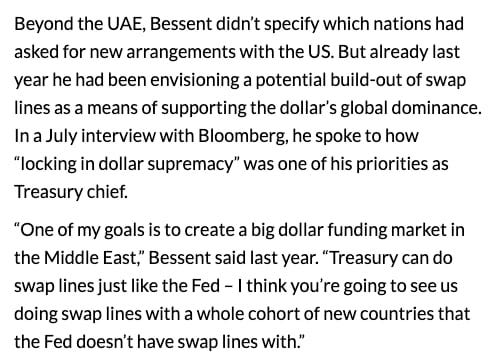
The expansion also reflects what analysts have termed the “Bessent Doctrine”—a shift from the Fed’s traditional, technocratic model of swap line provision to a more explicitly political framework managed through the Treasury. Bessent stated in July 2025 that “locking in dollar supremacy” was a priority, and that he intended to create “a big dollar funding market in the Middle East” using Treasury swap lines for “a whole cohort of new countries that the Fed doesn’t have swap lines with”.
This is precisely what is now unfolding. The UAE has over $2 trillion in sovereign investment assets and does not, by its own account, require external financial backing. What a swap line provides is not a bailout but admission to an elite tier of dollar-system membership—and a mechanism to ensure that even wealthy Gulf states do not begin, under sustained energy market pressure, to conduct oil transactions in yuan. Emirati officials reportedly warned that without dollar liquidity access, the country might need to consider alternative currencies for oil sales. The swap line forecloses that possibility.
Integration With the Trap
The swap line expansion adds a fourth dimension to our framework. The original three stages—kinetic squeeze, financial mirage, currency ambush—operate on the target. The swap line architecture operates on everyone else. It is the containment mechanism that isolates China’s reserve drain within a reinforced dollar perimeter, ensuring that the crisis engineered in the energy and currency markets does not spill over to challenge dollar hegemony. Instead, it structurally reinforces it.
The pieces continue to align.
Read The Petroyuan Trap here.