
Thiel, Vance and the clamp on Leo XIV

Today I am providing my English translation of an article by Margherita Furlan, originally in Italian and published on AntiMafiaDuemila.com on Thursday 14th April 2026.
(Bold emphasis original, italics and footnotes mine).
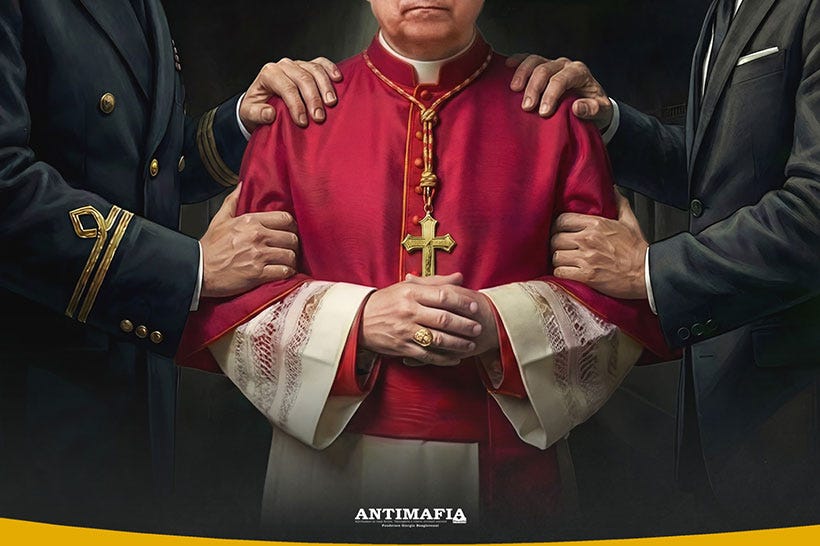
The Pentagon and Palazzo Taverna: two tracks, a single operation against the Pope’s teaching
There is a dark thread linking three seemingly unrelated episodes: the summons, in January 2026, of the Apostolic Nuncio in Washington to the Pentagon; the series of lectures on the Antichrist that Peter Thiel gave in Rome, at Palazzo Orsini Taverna, from 15th to 18th March [2026]; the “final and best offer” that Vice-President JD Vance delivered to Tehran last night in Islamabad, before returning to Washington without an agreement. Three tracks – military-state, ideological-theological, diplomatic-ultimatum – converging on the same target: the authoritative voice of Leo XIV, the first US Pope in history, who in a matter of months has become the most formidable obstacle to the Trump-Vance administration’s war strategy against Iran and to Silicon Valley’s technocratic theology.
The meeting at the Pentagon: the shadow of Avignon
The account was published by Mattia Ferraresi in the American magazine The Free Press and republished in Italy in Domani1 on 10th April 2026. Last January, a few days after a speech in which Leo XIV had denounced “diplomacy based on force”, the Under-Secretary of Defence for Policy, Elbridge Colby, summoned the then Apostolic Nuncio to the United States, the French Cardinal Christophe Pierre, to the Pentagon. A move that was already irregular in terms of protocol: diplomats from a State without an army [but even those with an army, as far as I know] are normally received at the State Department, not at the command centre of the most formidable military machine in history.
The message delivered to the cardinal, according to Vatican sources cited by The Free Press, was of a brutality without recent precedent in relations between Washington and the Holy See: the United States had the military power to do as it pleased in the world, and the Catholic Church would do well to side with them. To make the warning even more explicit, one of the officials present invoked the precedent of Avignon, the 14th-century period when the French Crown militarily subjugated the Bishop of Rome to its will. A historical reference that the Vatican’s diplomatic corps interpreted as a clear attempt to curtail the universal independence of the papal throne.
The Pentagon has formally denied the account, describing it as “grossly exaggerated and distorted” and speaking of a “respectful and reasonable discussion”. But the denial is limited to form, not substance: the meeting took place, and in a location that no diplomatic protocol would have chosen. Vice-President JD Vance, approached by journalists in Budapest, promised “clarity”, whilst admitting, however, that he did not know who Cardinal Pierre was – a detail of no small importance for a Catholic convert who builds his public identity in part on his faith.
According to Vatican sources, there are three reasons for the cooling of relations: disagreements over the administration’s foreign policy, the growing opposition of American bishops to the mass deportation programme, and the Holy See’s refusal to become a partisan trophy ahead of the 2026 midterm elections. The Vatican’s response came on a symbolic level: the papal press office had already announced in February that “the Pope will not visit the United States in 2026”; it was subsequently announced that on 4th July, the 250th anniversary of American independence, Leo XIV will visit Lampedusa. Not the South Lawn of the White House, but the island of migrants who have died in the Mediterranean. A choice that speaks louder than any diplomatic note.
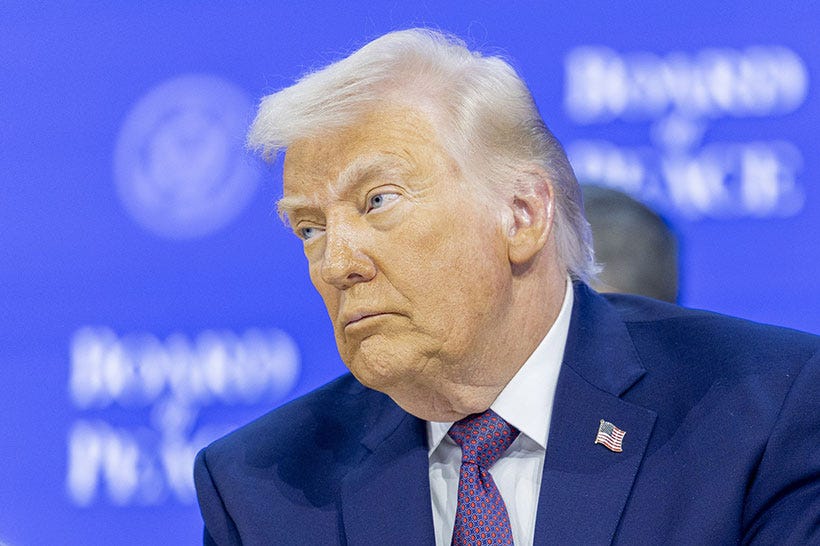
Palazzo Taverna: the Antichrist as a political weapon
Whilst the Pentagon works on the military front, the ideological side is being personally overseen in Rome by Peter Thiel. From 15th to 18th March 2026, the founder of PayPal and Palantir Technologies, a long-standing financier of Donald Trump and political mentor to JD Vance, holds four closed-door conferences at Palazzo Orsini Taverna, in the heart of the historic centre, a stone’s throw from the Vatican. The title: The Biblical Antichrist. The organisational framework is twofold: the Brescia-based Vincenzo Gioberti Cultural Association, of a Catholic-conservative orientation, and the Cluny Institute, an initiative founded within the Catholic University of America. Attendance by invitation only, secret guest list, ban on mobile phones and recordings.
In the audience, according to reports by Open and La Repubblica2, a carefully selected group: the editor-in-chief of Il Tempo3, Daniele Capezzone, alongside his predecessor, Roberto Arditti; Oliviero Bergamini and Barbara Carfagna of RAI4; the founder of Chora Media5 and financier Guido Maria Brera; the historian Giovanni Orsina; Alberto Mingardi of the Bruno Leoni Institute, the [right-wing party] Lega’s foreign affairs representative for youth affairs, Davide Quadri, Cristiano Cerasani, an aide to Chamber of Deputies President Lorenzo Fontana, and – a detail not to be overlooked – Antonio Zanardi Landi, the Order of Malta’s ambassador to the Holy See. A Catholic diplomatic channel seated in the hall where Thiel was constructing the theological framework for the anti-Leo XIV operation.
The attempt at Vatican legitimisation had started out even more ambitiously. Before the event, persistent rumours had circulated about a series of conferences to be held at the Angelicum, the Pontifical University of St Thomas Aquinas. The university was forced to issue an official denial signed by the rector, Father Thomas Joseph White. According to accounts that are difficult to verify but reported by RSI6, Leo XIV himself is said to have expressed reservations about Thiel’s presence at the Angelicum, asking, via Secretary of State Pietro Parolin, for the bookings to be cancelled. Other rumours suggest that Thiel had advised Vance to ignore the Pope’s moral objections regarding artificial intelligence. The structure mirrors that of Pierre’s summons: where the Pentagon uses military threats, Thiel attempts symbolic absorption within the papal walls. In both cases, the Vatican rejects the proposal.
The overturned katechon
The ideological core of the lectures at Palazzo Taverna is an operation of overturning. Father Antonio Spadaro, a Jesuit, summarised it with surgical precision: the practical conclusion of Thiel’s theo-technocratic message is that any attempt to regulate artificial intelligence, to establish bodies of global governance or to curb technological development becomes, within this framework, a preparation for the reign of the Antichrist. The Johannine category – which in Christian tradition identifies the latter as the one who denies the Incarnation of the Word – is stripped of its theological content and transformed into a political-cultural tool: the Antichrist is whoever hinders innovation, whoever sets limits, whoever regulates.
To gauge the extent of this reversal, we must recall what the category of the Antichrist is in Christian tradition. It is a technical term, and has but one source: the Apostle John. He coins it in his Epistles, and is the only New Testament author to use the Greek word antíchristos. In the First Epistle, chapter 2, John writes: “Who is the liar but he who denies that Jesus is the Christ? The Antichrist is he who denies the Father and the Son”. In chapter 4, he further refines the criterion: “Every spirit that acknowledges Jesus Christ as having come in the flesh is from God; every spirit that does not acknowledge Jesus is not from God. This is the spirit of the Antichrist”. The definition is dogmatic, not political: the Antichrist is he who denies the Incarnation of the Word, that is, the foundational truth of the Christian faith, upon which everything else depends, from the Trinity to Redemption. There may be bloodthirsty empires, ferocious tyrants, inhuman economic systems: according to patristic tradition, from Irenaeus to Augustine to Thomas, none of this is in itself “the Antichrist” in the Johannine sense, unless it takes the form of an explicit denial of the “Word made flesh”.
Thiel takes this powerful, ancient, well-defined category and detaches it from its original meaning. In the Palazzo Taverna lectures, the Antichrist is no longer the one who denies the Incarnation: it is the one who seeks to regulate artificial intelligence, who places limits on innovation, who preaches degrowth or ecological caution. He states this explicitly, citing his two favourite examples: “someone like Greta or Eliezer”, referring to Greta Thunberg and Eliezer Yudkowsky, the American theorist of the existential risk posed by artificial intelligence. The emptying is twofold. First: the original theological content – the denial of the Incarnation – is removed. None of the figures Thiel places in this category are denying that Jesus is the Christ: these are matters of public policy, not dogma. Second: in place of that content, a new political content is injected, in which the Antichrist becomes a category of enemy, a container for everything that opposes unlimited technological capitalism. It is, in technical terms, a secularisation of a theological concept in the exact sense in which Carl Schmitt, in his 1922 Political Theology, argued that “all the significant concepts of modern State doctrine are secularised theological concepts”. Thiel applies the Schmittian method to the letter: he takes a sacred term and transforms it into a political weapon.
Avvenire7 also picked up on this immediately, denouncing the “pseudo-theological” nature of the operation in an editorial in the L’Armonauta column: Thiel’s Antichrist “is not about climate policy, it is not about welfare, it is not about the regulation of artificial intelligence”, and above all it is not about Leo XIV, who is the Vicar of Christ, the one who professes faith in the Incarnation every day. Yet it is precisely within this inverted framework that the Pope, with his calls for peace, diplomacy and limits on technological domination, finds himself automatically placed in the camp of the enemies of progress. The paradox is total and theologically incoherent: the Vicar of Christ, who professes the Incarnation every day, is placed on the side of the Antichrist by those who preach a secularised theology in which “Antichrist” effectively means anyone who wishes to regulate ChatGPT. But it is precisely this kind of paradox that works politically, because it exploits the symbolic power of sacred language to legitimise profane choices. It is the theological legitimisation of the pressures that, two months earlier, Colby had had delivered to Nuncio Pierre.
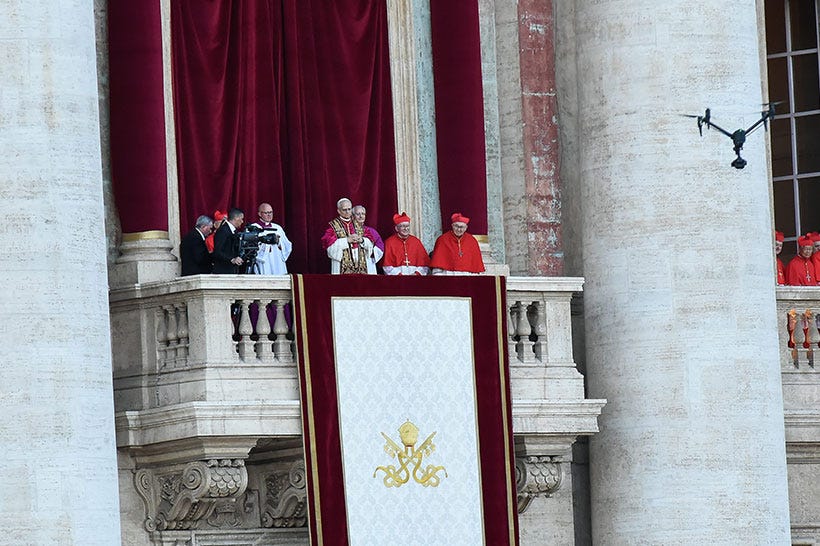
The intellectual lineage is explicit. Thiel draws on Carl Schmitt and the concept of the katechon, the “power that holds back” the advent of the Antichrist. For the Nazi jurist, the katechon was the sovereign order that rules in a state of exception. For Thiel, the katechon is algorithmic dictatorship, unlimited technological acceleration, the concentration of computational power in the hands of the few. It is a political theology that justifies, in the name of a secularised salvation, exactly what Palantir sells to governments: mass surveillance, predictive policing, military targeting systems.
The material nexus: Palantir within the Italian Ministry of Defence
While Thiel speaks of the Antichrist at Palazzo Taverna, Domani publishes an investigation that makes the picture brutally concrete. The Ministry of Defence, led by Guido Crosetto, launched in 2024, through Teledife (the Directorate for Information Technology, Telematics and Advanced Technologies), a negotiated and classified procedure for the supply of a Palantir Gotham user licence, worth one million Euros. Neither the duration nor the successful bidder are known. Gotham is the data analysis and correlation software used by the American ICE [Immigration and Customs Enforcement] to identify and deport migrants, by the Israeli armed forces in Gaza for targeting systems, and – according to international reports – also employed in operations to track Iran’s Supreme Leader Ali Khamenei and in missions against Nicolás Maduro in Venezuela.
The relationship between Palantir and Italy is not a one-off. It dates back to 2012, the year Palantir Italia S.r.l.8 was established, and consists of a series of contracts managed by Teledife from 2015 onwards. Added to this is the [hospital] Policlinico Gemelli, which in 2023 signed a partnership for the management of clinical data.
And there is the still-pending dossier regarding the software proposed to the State Police for 20 million Euros over 4 years, halted – at least for now – by the Interior Ministry and the Prime Minister’s Office, which are calling for a public tender. In the background lies the NATO constraint: since March 2025, the Alliance has formalised the acquisition of the Palantir Maven Smart System, and interoperability means that Italy’s dependence on the American supplier is no longer a choice but a structural obligation.
Palantir is an arm of the US national security apparatus, and when European governments acquire its tools, they are not buying software but ceding sovereignty. The pattern, in Italy as in the UK, is always the same: first healthcare, then defence, then law enforcement. A crisis arises, a solution is offered, and the provider becomes indispensable. And leaving costs more than staying.
Islamabad, the “final and best offer”
The picture has come into focus in the last few hours. At dawn today, Sunday 12th April [2026], after twenty-one hours of negotiations in Islamabad, as we write, Vice-President JD Vance has left Pakistan aboard Air Force Two without a deal. Speaking to reporters at a press conference lasting just over three minutes, flanked by Steve Witkoff and Jared Kushner, he delivered the line destined to make the headlines: “We are leaving this place with a very simple proposal, a framework for an agreement that is our final and best offer. We will see if the Iranians accept it”. And again, in a harsher tone: “This is bad news for Iran far more than for the United States of America. We have made our red lines very clear, and they have chosen not to accept our terms”.
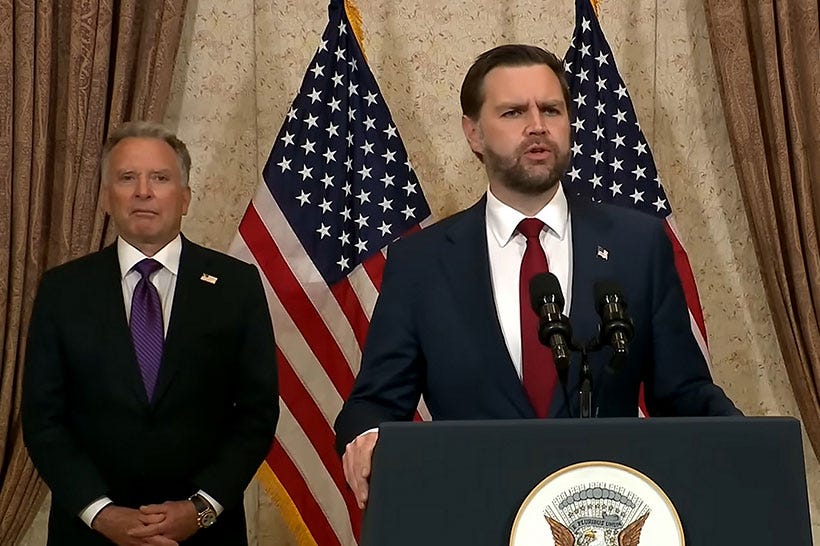
What these red lines are was clarified by reports leaked from Pakistani, American and Iranian sources in the hours that followed. The three issues over which the talks broke down are exactly those that were predictable: the nuclear programme and the stockpiles of 60% enriched uranium (around 970 pounds, according to IAEA9 estimates from June 2025), control of the Strait of Hormuz; and the Iranian demand – rejected by the Americans – that the ceasefire be extended to Lebanon, where Israel continues daily bombardments amid an ongoing invasion, with a death toll of 2,020 reported by the Lebanese Ministry of Health. Vance publicly reiterated the demand for Iran to renounce “not just today, not just in two years time, but in the long term” any nuclear capability; on the extension of the ceasefire to Lebanon, he remained silent. Silence, in cases such as this, speaks volumes.
Translated into the three points that comprise it, Washington’s “final and best offer” reads as follows: full handover of Iran’s stockpile of enriched uranium, reopening of the Strait of Hormuz under American control (one of the key points of the 15-point plan delivered to Tehran via Islamabad on 25th March [2026]) and a free hand for Tel Aviv to continue its operation against Hezbollah and Lebanese civilians. Three conditions which, taken together, amount to a surrender without a ceasefire for Iran. A few minutes after the announcement that the negotiations had failed, Donald Trump declared on his social media account that the United States would initiate a naval blockade of the Strait of Hormuz “with immediate effect”. The two-week ceasefire expires on 21–22 April [2026].
Vance had departed from Joint Base Andrews on Friday 10th April [2026], warning that if the Iranians tried to “play games”, they would find a delegation “not particularly receptive”. He returned to Washington on the same day that, on the Vatican front, Leo XIV continued to describe the administration’s threats against the Iranian people as “unacceptable”. The distance between the two points – Air Force Two flying towards the White House, Castel Gandolfo10 speaking of peace – is the space in which the pincer movement we describe in this piece is being played out today. On one side, a Catholic convert vice-president bringing an offer to Tehran couched in the terms of an ultimatum; on the other, a Pope who, since January [2026], has been threatened through his nuncio to stop disrupting that very offer.
The pincer
Viewed separately, the three episodes – Pierre’s summons to the Pentagon, Thiel’s lectures at Palazzo Taverna, Vance’s ultimatum in Islamabad – seem to belong to incompatible registers. Read together, they reveal the same architecture. On the one hand, the military power ordering the Holy See to remain silent on the war crimes in Iran, evoking the spectre of Avignon. On the other, Vance’s political backer who, a few hundred metres from St Peter’s, constructs the theological framework whereby anyone who sets limits on artificial intelligence and technological power becomes a figure of the Antichrist. In the middle, today, a “final and best offer” demanding that Tehran hand over its uranium, its maritime sovereignty over the Strait of Hormuz, and stand by in silence as Lebanon is destroyed. Vance is the political link that binds the three fronts together. Palantir is the industrial link which, through the classified contract with the Italian Ministry of Defence, brings the same logic into our country’s sovereignty.
Leo XIV condemned the American attacks on Iran on 28th February as “illegal and immoral”, described Trump’s threats to the Iranian people as “unacceptable”, and invoked in his Easter Urbi et Orbi11 blessing that “those who have the power to unleash wars may choose peace’. The pincer tightening around him is not a mere series of coincidences. It is the form that war takes, in this era, as a product: no longer just the military industry, but theology, surveillance, a platform. A single supply chain, three different languages.
One question remains, and it concerns Italy. Whilst the Vatican seeks to resist in its own way – with the Pope choosing Lampedusa over the South Lawn – the Italian government is secretly signing contracts with the very same company whose founder preaches, just a kilometre from St Peter’s Basilica, that anyone who curbs technological power is a figure of the Antichrist. It is on this contradiction – between the sovereignty one claims to wish to defend and that which is ceded through administrative channels, within secret procedures removed from parliamentary debate – that the sincerity of those in Rome who declare themselves Catholic, conservative and patriotic will be tested in the coming months.
Copyrighted images have been used for non-commercial purposes and fall within the scope of fair use.
Italian newspaper whose name means Tomorrow
Two Italian mainstream newspapers, the first one published only online
Another Italian mainstream newspaper
RAI Radiotelevisione Italiana, formerly known as Radio Audizioni Italiane, is the national public broadcasting company of Italy, owned by the Ministry of Economy and Finance
Italian podcast company
Radiotelevisione Svizzera di lingua Italiana, i.e. Swiss Radiotelevision of the Italian Language
Italian daily newspaper affiliated with the Catholic Church
Società a responsabilità Limitata, that is Limited Liability Company (LLC)
International Atomic Energy Agency
Summer residence and vacation retreat for most popes since 1626
Latin for “to the city (of Rome) and to the world” - it refers to a papal address and apostolic blessing given by the Pope on certain solemn occasions