
The words that govern the present
Not a barrier, but a form of civilisation: the history, meaning and crisis of a word that has become unpronounceable.

Today I am providing my English translation of an article by the editorial office of InchiostroNero (literally meaning Black Ink), originally in Italian and published on ComeDonChisciotte.org on Sunday 3rd May 2026.
(All formatting original, footnotes mine).
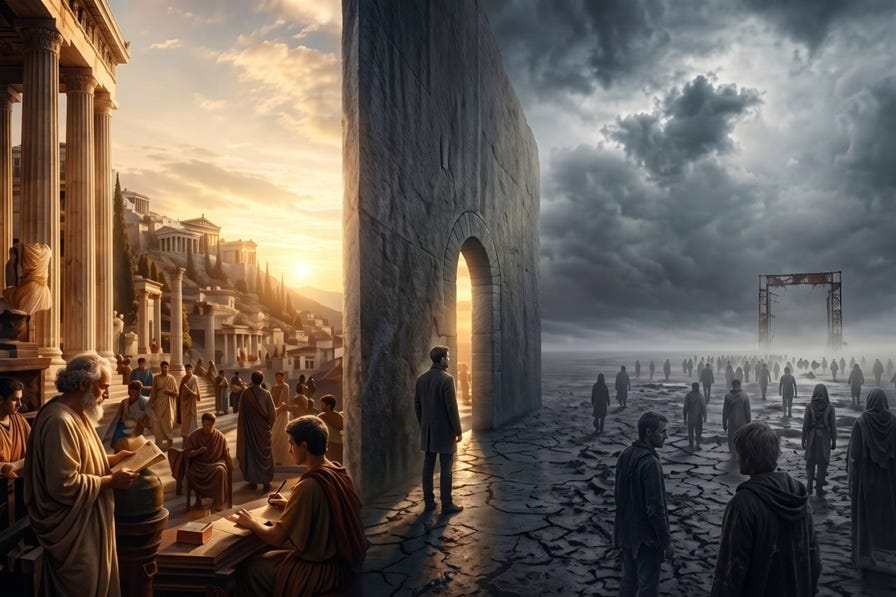
«The border: the word the West can no longer bring itself to utter»
Not a barrier, but a form of civilisation: the history, meaning and crisis of a word that has become unmentionable
For centuries, the border has been one of the fundamental tools through which societies have built order, identity and political accountability. Today, however, the word itself arouses mistrust or embarrassment, as if to speak of a border automatically meant to invoke exclusion or isolation. Yet no community can exist without distinguishing between inside and outside, between what protects and what exposes.
This essay traces the cultural history of the concept of the border – from antiquity to modernity – showing how its delegitimisation has not eliminated borders, but has rendered them invisible and more difficult to govern. Recovering its meaning does not mean defending walls: it means returning to thinking about the form of coexistence.
There is no openness without form, and there is no form without a border
A word that has become suspect
In contemporary political discourse, there are words that describe reality and words that judge it even before naming it. Border now belongs to this second category. It is no longer perceived as a geographical word nor as a legal term: it has become a moral word. And, above all, a suspect word.
To utter it almost always means having to justify it. It means explaining that one is not calling for closure, exclusion or hostility. In other words, it means defending oneself even before one has argued one’s case. It is a sign that something, in the relationship between political language and the collective imagination, has cracked.
Yet no civilisation is born without boundaries. No historical community takes shape without establishing an inside and an outside, a near and a far, a “one’s own” and a “not one’s own”. Delimitation is not an aggressive act: it is a founding act. It is the moment when a space becomes habitable, a memory becomes shared, a responsibility becomes recognisable.
When the boundary ceases to be conceived as a structure of coexistence and is interpreted exclusively as a barrier, a significant reversal occurs: what for millennia has made political life possible is reinterpreted as an obstacle to its realisation. This is not a neutral transformation. It is a paradigm shift.
Every community exists because it distinguishes. It does not distinguish to exclude, but to recognise. It does not distinguish in order to separate itself from the world, but to be able to situate itself within the world. Without distinction, there is no collective responsibility, no historical continuity, no transmissible identity.
For this reason, the contemporary difficulty in naming the boundary is not merely a linguistic fact. It is a cultural symptom. It is the sign of a civilisation that is finding it increasingly difficult to define its own contours.
As Carl Schmitt observed with clarity: “Every concrete order presupposes a spatial distinction”. A distinction that does not arise from fear, but from the need to give form to human coexistence.
And it is precisely this need – today – that is proving increasingly difficult to recognise.
The boundary in the ancient world: a measure rather than a barrier
In the ancient world, the boundary was not conceived as a defensive line nor as a hostile means of separation. It was, first and foremost, a measure. For the Greeks, the boundary did not represent a restriction of freedom, but its very condition. Civilisation arose from the ability to recognise the threshold beyond which human action becomes excess. The decisive opposition was not between openness and closure, but between métron1 and hybris2: between the form that makes the world habitable and the excess that disrupts it.
This awareness runs through the entire Greek experience. Man is not free because he is unlimited, but because he is capable of moderation. Tragedy itself teaches this: the hero does not fall because of an external obstacle, but because of his inability to recognise the limit that underpins human order. In this sense, the boundary is not a barrier: it is the condition for the stability of communal life.
Rome transformed this insight into a historical institution. The limes3 was not simply a military frontier, nor a wall intended to isolate. It was a legal and symbolic space. It marked the point within which the law provided protection and beyond which began an area not yet ordered according to the same legal structure. The Roman boundary did not merely indicate a geographical distance: it indicated the concrete extent of political responsibility.
Within the limes lay citizenship, the continuity of the law, the possibility of a shared history. To delimit meant to make order possible, not to prevent its expansion. It is no coincidence that classical thought emphasises moderation as the principle of coexistence: “moral virtue consists in the right middle ground with regard to ourselves”, writes Aristotle in the Nicomachean Ethics, identifying moderation not as a renunciation, but as the very form of human equilibrium.
For this reason, in the ancient world, the border did not merely separate two territories: it distinguished between two forms of order. It was not a defensive act, but a founding one. And it is precisely this idea – now almost forgotten – that constitutes one of the deepest roots of European civilisation.
The biblical boundary: separating to make the world habitable
While in the Greek world the boundary is measure and in the Roman world it is a legal form, in the biblical tradition it takes on an even more radical meaning: it becomes a creative principle. The boundary does not arise as a response to a threat, but as an original act through which the world takes shape. Even before being political, the boundary is cosmological.
The account in Genesis does not describe creation as an indistinct expansion of matter, but as a series of separations. God separates light from darkness, the upper waters from the lower waters, the land from the sea. He does not simply create elements: he orders them. And to order means to delimit. Creation itself thus presents itself as a process of progressive distinction that renders the world intelligible and habitable.
To separate does not mean to divide in order to exclude. It means to distinguish in order to make life possible. Without distinction there is no orientation, no time, no recognisable space. The boundary, in the biblical vision, is not a limit imposed on humanity: it is the condition enabling humanity to inhabit the world without being lost in the primordial chaos.
This principle is also particularly evident in the distinction between sacred time and ordinary time. The Sabbath is not merely a day different from the others: it is a delimited time, withdrawn from the indistinct continuity of production and restored to meaning. Here, separation becomes memory. It becomes rhythm. It becomes the measure of existence.
From this perspective, the boundary is never a negative act. It is an act of responsibility. Only what is distinct can be safeguarded. Only what is delimited can be recognised. Only what has a form can enter into a relationship with the other without dissolving.
For this reason, the contemporary loss of the sense of the boundary does not merely represent a political transformation. It is a deeper transformation: it concerns the very way in which Western man conceives of the order of the world. It is not merely public discourse that has ceased to name the distinction. It is the cultural imagination that has forgotten that, from the very first pages of Genesis, inhabiting the world means first and foremost learning to recognise thresholds.
As we read in the creation story: “God separated the light from the darkness” (Genesis 1:4). Not an act of division, but the first act through which the world became habitable.
When the boundary becomes a moral issue
From the onset of European modernity, the boundary slowly began to shift in meaning. It does not disappear – as is often claimed – but loses its symbolic legitimacy. It is a decisive transformation, because it concerns not only politics: it concerns the imagination. From the 18th century onwards, a new idea of humanity and history gradually took hold, founded on abstract universalism, on cosmopolitanism understood as a normative horizon, and on faith in progress perceived as potentially limitless. In this context, the border appears less and less as a framework for coexistence and increasingly as a relic of the past.
The European Enlightenment plays a central role in this shift. The idea that humanity can recognise itself in a common reason, valid everywhere and for everyone, brings about a profound transformation in the relationship between space and politics. If man is first and foremost the bearer of universal rights, territory progressively loses its foundational value. The border thus begins to be perceived as a historical relic destined to dissolve with the advance of civilisation.
In this context, a new moral sensibility emerges. Delimiting becomes suspect. Distinguishing becomes problematic. Defending a political space increasingly appears as a regressive act. The border is no longer interpreted as a condition of order, but as an obstacle to freedom. Not as a form of responsibility, but as a sign of fear.
Yet this transformation produces an unexpected effect. By eliminating the symbolic value of the border, communities also gradually lose the ability to recognise themselves as historical subjects. When the political space ceases to be perceived as a place of shared responsibility, it becomes difficult to determine what must be preserved, passed on and defended.
This is not a matter of lamenting a closed or static past. European civilisations have always been open civilisations. Their development was made possible precisely by their ability to cross borders, to engage in dialogue with others, to transform themselves. But crossing a border presupposes that the border exists. Only that which has a form can open up without dissolving.
For this reason, the modern transformation of the meaning of the border has not simply broadened the horizons of the European people. It has introduced a new tension: a civilisation that tends to think of itself as universal risks slowly losing the ability to define itself. And when a community can no longer describe its own contours, it inevitably struggles too to recognise its own continuity over time.
The contemporary paradox: a borderless world that builds invisible walls
One of the most characteristic features of our time is the widespread belief that we live in a world that has transcended borders. Economic globalisation, increasing mobility and the instantaneous circulation of information have fuelled the idea that the traditional political space is now a relic of the past. From this perspective, the territorial border appears as a mechanism destined to weaken progressively until it disappears.
Yet what we are witnessing is not the end of borders. It is their transformation.
While the political border is being delegitimised on a symbolic level, new forms of demarcation are multiplying, often more rigid and less visible. They do not separate territories, but opportunities. They do not distinguish between states, but between possibilities of access. They do not draw lines on maps: they cut across the fabric of everyday life.
Economic borders are among the most significant today. The free movement of goods and capital does not equate to the free movement of people. The gap between those who participate in global decision-making circuits and those who remain excluded translates into a new geography of inequality, often more effective than any traditional border.
Alongside these, social borders are becoming increasingly difficult to cross. Access to education, professional mobility and social networks produces new forms of separation that do not declare themselves as such, but operate with great consistency. They are not visible boundaries, but they are real boundaries.
Even more profound are technological boundaries. The ability to participate in public life, to access information and to navigate the digital space depends increasingly on access to tools that are not distributed evenly. The internet, often described as an open space by definition, is in reality criss-crossed by invisible thresholds that distinguish those who can act from those who can only be subjected to events.
Finally, there are informational boundaries, perhaps the most difficult to recognise. They do not merely separate what is true from what is false. They separate what is visible from what remains invisible. In a saturated communicative environment, the very possibility of finding one’s way becomes a form of privilege.
The result is an obvious paradox: while the territorial border is presented as an outdated structure, more subtle and pervasive borders emerge. The border never disappears. It changes form. And when a society ceases to recognise its own visible borders, it often ends up being governed by invisible borders that are far more difficult to understand and far more difficult to cross.
Border does not mean exclusion
One of the most widespread misunderstandings in contemporary debate is to equate the border with the wall. It is a conceptual error even before it is a political one. The wall separates without mediation; the border distinguishes, making relationship possible. The wall interrupts; the border orders. To confuse the two is to lose sight of the historical and anthropological function of demarcation.
The border is not created to deny the other. It is created to recognise them. Only where there is a recognisable threshold can there be an encounter that is not confusion. A community capable of defining its boundaries is not a closed community: it is a community aware of its own responsibility. It knows what it safeguards, what it transmits, what it shares.
In this sense, the border is a form of coexistence. It does not represent a moral barrier, but a structure of reciprocity. Without borders there is no recognisable political space, and without a recognisable political space there is no collective responsibility. There is no “we” capable of engaging in dialogue with a “you”.
The great European civilisations did not build their history by eliminating borders, but by making them crossable without dissolving them. The border, in its original function, is not closure but orientation. It is not hostility but form. It is not exclusion but order.
For this reason, the contemporary difficulty in distinguishing between a border and a wall often produces an ideological simplification that prevents us from understanding the very nature of political life. Only that which has a border can enter into a relationship with something else. Only that which possesses a form can open up without dispersing. And it is precisely this awareness that today, more than any other, seems to have weakened.
The border and the crisis of European identity
The question of the border today concerns not merely border policy. It concerns something deeper: the way in which Europe conceives of itself. Every civilisation, in order to exist historically, must be able to distinguish what it considers its own from what it considers other, what it intends to preserve from what it intends to transform, what it recognises as common from what remains external. When this capacity weakens, it does not merely produce an administrative or institutional difficulty: it produces a symbolic difficulty.
What does Europe defend today? What does it truly consider its own? What legacy does it still deem worthy of being passed on? These are questions that are rarely formulated explicitly, and precisely for this reason they continue to operate at a deep level. A civilisation can weather economic crises or political transformations without losing itself. But it is unlikely to survive for long if it loses the ability to recognise its own boundaries.
For centuries, Europe has built its identity not through isolation, but through a constant tension between demarcation and openness. It is this tension that made possible the emergence of universities, public law, cities as places of citizenship, and representative institutions. It was not the absence of borders, but an awareness of them, that made communication between differences possible.
Today, this awareness seems to be waning. The border is increasingly perceived as a problem to be removed rather than a reality to be understood. But a civilisation that no longer knows how to name its own borders inevitably struggles to name itself as well. And when a community ceases to recognise what makes it recognisable, it becomes difficult to determine what deserves to be preserved and what can be shared with the rest of the world.
A word to be reclaimed
Reclaiming the word border does not mean reviving models of the past or calling for closures that European history has never truly practised. Rather, it means returning to the recognition of one of the fundamental conditions of political life. Every community exists because it delimits a space of responsibility, because it distinguishes what it can safeguard from what can only pass through, because it recognises that coexistence does not arise from indistinctness but from form.
In this sense, the border is not a line on a map. It is a structure of historical memory. It is the place where a community decides what to pass on and what to transform. It is the point at which a civilisation recognises that it is something defined and not simply a surface open in every direction.
For this reason, the border is not the opposite of openness. It is its condition. Only that which possesses recognisable contours can enter into a relationship without dissolving. Only that which has a form can engage in dialogue with the other whilst maintaining continuity with itself.
It is no coincidence that the contemporary difficulty in naming the border has gone hand in hand with the equally evident difficulty in naming the limit. The two words belong to the same grammar of historical responsibility. Both indicate a threshold that does not serve to restrict human action, but to make it directable.
Perhaps this is precisely the crux of the matter. The crisis of the border concerns not only border policy. It concerns the way in which a civilisation conceives of itself over time. And the growing hesitation to utter its name probably says more about our present condition than many analyses devoted to the conflicts of our time.

In ancient Greek, the word μέτρον had a variety of meanings. The basic meaning is the "measure, size, length" of something - Wikipedia
In ancient Greek, hybris referred to “outrage”: actions that violated natural order, or which shamed and humiliated the victim, sometimes for the pleasure or gratification of the abuser - Wikipedia
Latin for boundary or border