
A Trail of Tears
I spent ten days travelling through the territories that are at the heart of Russia’s Special Military Operation (SMO) against Ukraine. What I learned bouyed my spirits and broke my heart.
I embarked on this journey to empower myself to be able to better assess the realities associated with a conflict that has entered its fifth year. I left bearing the burden of how to tell the story of people who have been living under the conditions of war for more than twelve years.
The vision of this trip began to come together in November of last year. I was in Moscow, doing media interviews about the SMO, and was struck by the realization that for the most part the “informed” conversations taking place were between people who simply had no first-hand experience in what they were talking about. While the discussions weren’t superficial, and indeed covered the topics addressed responsibly, for me it was more of an academic exercise than an expression of the kind of deep insight that can only come from doing and seeing things for yourself. The whole purpose behind my coming to Russia in the first place was to capture the Russian reality so that I could better explain it to a Western audience. I decided then and there that a visit to the SMO was an absolute necessity.
I had last visited the SMO region in January of 2024, a lightening quick dash through the region which enabled me to say that I had “been there and done that”, but little more. Even if the visit had been of a longer duration, there was a need to refresh my personal database. The war in the SMO had progressed from that time to the point that any discussion of the conflict drawing upon two-year-old experiences would simply be an exercise in intellectual frustration.
The developments in drone warfare alone made the present situation so far removed from past experiences as to represent a completely new reality.
I had to go and see for myself.
June is a “hot” month in the SMO for any number of reasons. The land has thawed out from the winter snow and dried out from the muddy spring season (Rasputitsa). The war would be firing on all cylinders, and the drones would be flying. I was scheduled to come to Russia to attend the Saint Petersburg International Economic Forum (SPIEF) in early June, and so I decided to extend my visit to allow for a more extended tour of the SMO that would give me the opportunity to witness first hand the realities of a land and people locked in a conflict few in the West understood.
The SMO is very much a war zone, and most definitely not a tourist destination (although once this war ends, these territories should be visited by everyone so that the beauty of the land and the character of its people can be experienced by all.) One cannot simply get into a car and drive to the SMO on their own.
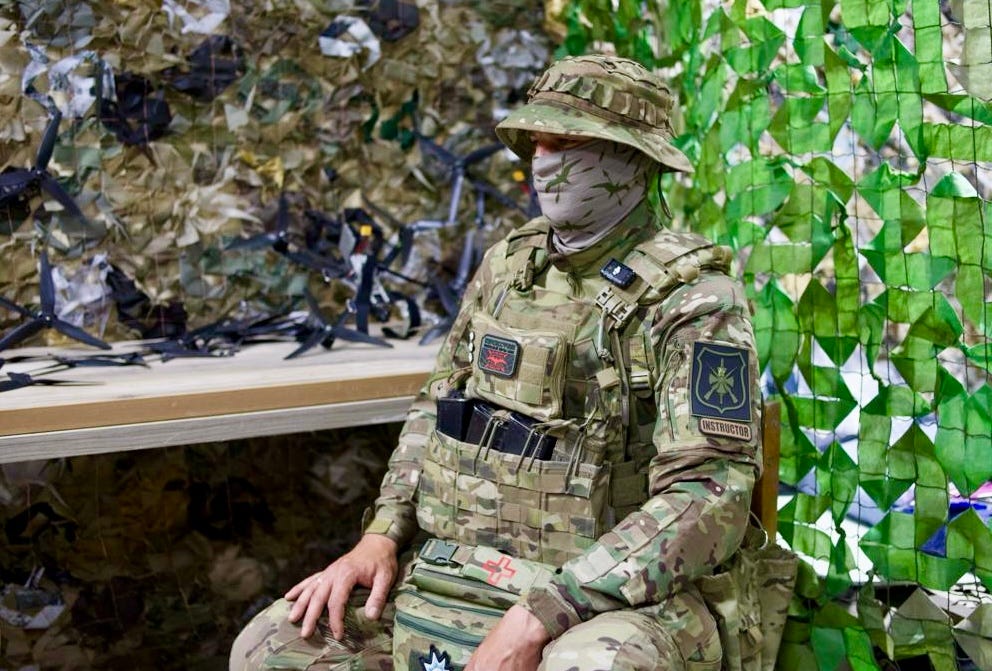
I had decided that the focus of my effort would be to better understand drone warfare, both as it was applied in and around the SMO, but also in general—drone warfare, in my view, represents a revolution in military affairs, and as such must be understood as a standalone topic I reached out to a good friend of mine, who goes by the callsign “Iskander”. He is a decorated hero of the SMO who was awarded the Order of Courage for his actions during the fighting to recapture the town of Sudzha from the Ukrainian military in the spring of 2025. “Iskander” was one of the original commanders of the “Burevestnik” drone unit, and as such I approached him to see if it would be possible to visit this unit and interview its personnel.
I also reached out to Alexandra Bagsley (a pseudonym; Alexandra, like other Russian administrators in the New Territories, has been targeted for assassination and her true identity is being protected), an administrator in the Zaporozhia region whom I met in Moscow in October 2025, and who invited me to come and visit the Zaporozhia nuclear power plant.
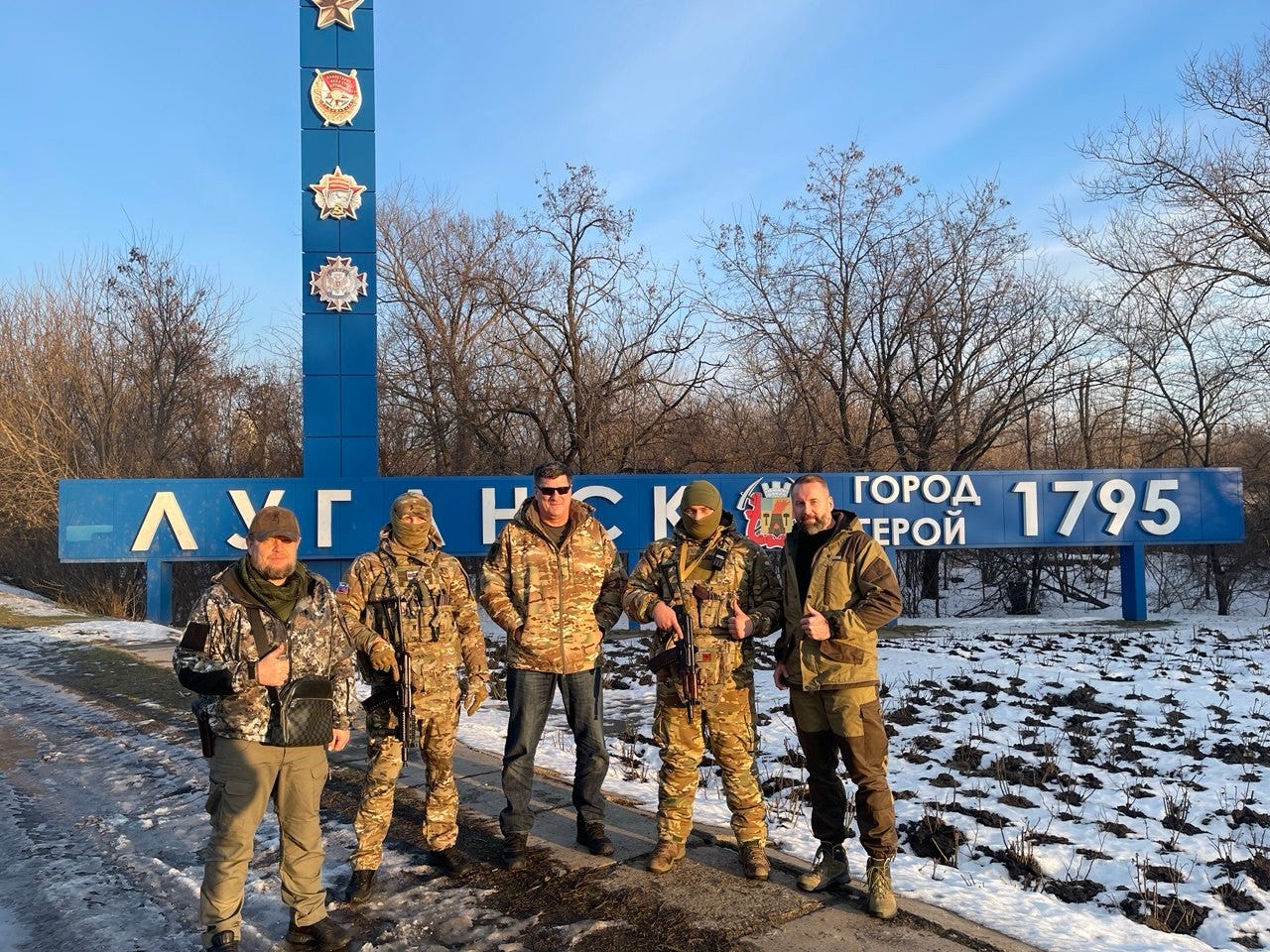
I drafted a two-week plan of action that would have me in the SMO for roughly two weeks, entering from Lugansk in the north, and travelling south through Donetsk, Zaporozhia, Kherson, before finally ending up in Crimea, and in March I met with “Iskander” to brief him on the concept. He was in contact with Alexandra Bagsley, and together they promised to come up with a combined plan of action that would meet my objectives.
I had originally planned on organizing transportation myself and had reached out to another SMO veteran with experience in delivering humanitarian goods to the region to see if I could hire him and his vehicle for the trip. “Iskander” quickly put an end to this idea—the situation in the SMO was growing more dangerous as each day passed, and if the trip was going to take place at all—and there were many in the Russian government who believed it was too dangerous to try—then it would have to be done under strict operational security overseen by a team possessing both the authority to take me to the region and the skill sets necessary to make the visit as safe as possible.
The team “Iskander” assembled were from Hollywood central casting. The team leader, with overall responsibility for security, went by the callsign “Angor.” He was a 20-plus year veteran of the Russian Special Forces from the Lipetsk region who may or may not still be on active duty. He had the relaxed, confident posture I had previously seen in members of Delta Force. He had started his military career as a soldier, patrolling Chechnya in the final year of that conflict. He didn’t extrapolate about his experiences beyond that, but the familiarity he had of the Donbas region implied that much of his time in service was spent in this region fighting against the Ukrainians.
“Shakh” was the grandson of a Ukrainian coal miner from the Donbas (“Shak” is short for “Shakhtar”, the Russian word for miner. He was the “fixer”, the man who would make things happen, although due to his size and level of physical fitness (he was a three-time Master of Sports in the Russian Federation), we jokingly referred to him as “the breaker.” “Shakh’s” military pedigree was uncertain, but his familiarity with men who were known to have served with the famous Russian private military company “Wagner” implied a common history. Both “Angor” and “Shakh” made it clear that inquiries into their past lives, and present affiliations, were not the preferred topic of conversation, and I did my best to respect their wishes.
“Hermes” was the ultimate quiet professional, a young man who hailed from Novosibirsk whose familiarity with “Angor” hinted at a common pedigree. He was the man for all seasons, the go-to guy for the minutia associated with journeys such as this—the driver, the car mechanic, the guy who found the gadget to fix the problems of life. He had a ready smile and friendly demeanor that hid a more serious side that manifested itself in the cool, calm way he got things done. You didn’t know “Hermes” was around until you needed him, and then he was there, getting the job done—the quintessential “grey man.”
Luna was the team interpreter. A graduate of the Moscow Institute of Foreign Languages named after the prominent French Communist Maurice Thorez—the most elite linguistic institution in Russia—Luna was born in the southern Russian city of Krasnodar, and raised in Rostov-on-Don, before moving to Moscow to attend university. An attractive lady with a quick wit and charming personality, Luna was more than just a competent linguist. She was a full-fledged member of her team, well-versed in the security protocols they followed and someone who was consulted whenever the team gathered to discuss how they would adjust to what ended up being constant modifications to the trip schedule due to the changing security situation in the SMO. She had a familiarity with the other team members born of shared experience, and while one could not pin her down as someone with a military background, one could not discount that possibility as well.
Artyom was a veteran combat correspondent who had been reporting from the SMO from the very beginning of the conflict. He was everything you needed to produce a video journal of the SMO journey all rolled into one—cameraman, sound engineer, video editor, music director. Artyom could do it all. I had spoke to “Iskander” about my desire to make a full-length documentary film about drone warfare, as well as desire to make a series of smaller video blogs derived from my experiences on the ground. All I asked for was a cameraman. Instead, I got Artyom—the “full package.” Like Luna, Artyom’s military pedigree was uncertain. He had the aura of an artist, a master of his trade, that was tempered by the kind of discipline and competence one rarely sees in pure civilians. Perhaps it was the fact that this trip wasn’t his first SMO rodeo—like Luna, Artyom possessed a strong familiarity with both “Angor” and “Shakh” that hinted at multiple joint experiences. Artyom also spoke excellent English, which enabled him to double as an impromptu interpreter if the situation warranted.
The last member of the team was Alexandra Madornaya, my “woman Friday” without whom my visits to Russia would not be possible. Alexandra was born and raised in the Siberian city of Chita, before moving to Novosibirsk and eventually Moscow. She started life in my universe as a moderator for my Telegram channel. Later she graduated to editing short videos I would make for Telegram. When my friend and former Russian host Alexander Zyrianov was arrested on what even the Russian media admits were fabricated corruption charges in June 2024, Alexandra filled the vacuum created by his absence. She collaborated with me to create The Russia House podcast, where she serves as producer, as well as helps produce and edit my SpotRep podcast and “Ritter’s Rant” YouTube project. Alexandra also took the lead in streamlining my Substack page, making it more accessible and user friendly.
When I resumed travelling to Russia in August 2025, Alexandra took on the role of “fixer”, coordinating my hotel accommodations and ground transportation, and renting out studios and hiring cameramen, linguists and sound engineers necessary for conducting the face-to-face interviews she had scheduled in support of The Russia House podcast. Alexandra was my intermediary with the media (Russian and foreign), as well as with Russian officialdom. In March of this year Alexandra accompanied Garland Nixon and I to Chechnya, where we conducted interviews and visits in support of a documentary film about life in Chechnya today. Alexandra will be editing the film. When I made the decision to go to the SMO, I wasn’t sure if Alexandra should come along. While I am more than willing to subject myself to certain risks, it would be the height of irresponsibility to ask her to share such danger. But she poured herself into the project, taking the lead on coordinating the schedule with both “Iskander” and Alexandra Bagsley. Moreover, Alexandra’s mother is a volunteer who has made numerous trips to the SMO to deliver humanitarian goods; this trip would be Alexandra’s chance to feel she, too, was making a contribution. After discussing the goals and objectives of the SMO visit, which included not just the drone documentary and video blogs, but also the need to publish articles for my Substack, Alexandra and I decided she should be a part of this trip. It turned out to be the right decision.
And so it was that this motley crew of adventurers departed Moscow on the morning of July 8, headed in a two-vehicle convoy for Lugansk. It is a long drive from Moscow to Lugansk, taking nearly twelve hours. During this time the team got to know each other better, and by the time we arrived in Lugansk we had developed an easy familiarity sprinkled with the kind of insider humor one can only get through shared experience. We settled in for diner that night in the hotel restaurant. Air raid sirens wailed throughout the meal, a clear sign that we were not in Kansas anymore, as Dorothy in The Wizard of Oz famously noted.
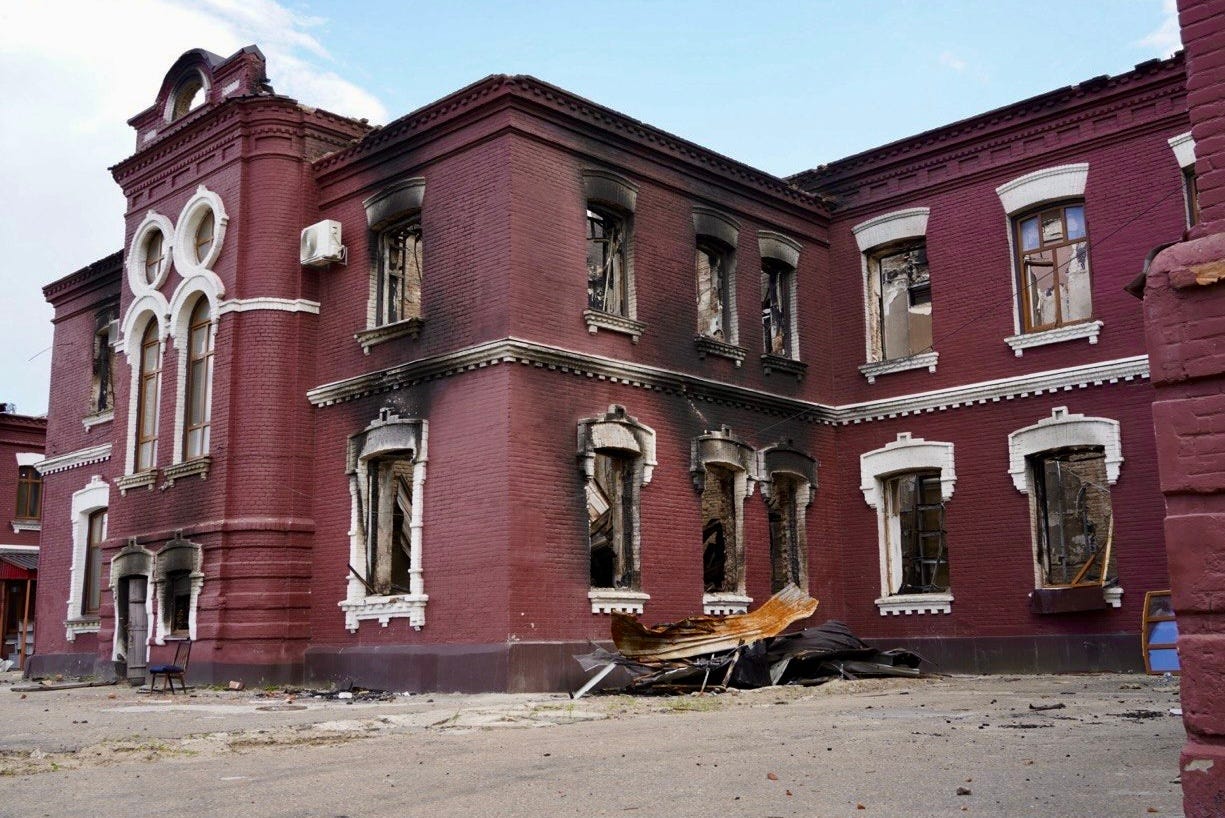
We began our work the next day, with a visit to Starobelsk, where we toured the ruins of the teacher’s college that had been attacked by Ukrainian drones on May 22, murdering 21 students in their sleep. We finished the trip nine days later in Melitopol, the interim capital of the Zaporozhia region. We had originally been scheduled to proceed from Melitopol to Kherson, but the roads were impassible due to Ukrainian drone attacks. Even if we would have braved the journey south, the harsh reality was the Ukrainians had severely damaged the Chonhar Bridge connecting Kherson with Crimea, meaning that any trip to Genichesk, the temporary capital of Kherson, would require a round-trip journey along the embattled M-18 highway. Simple risk-gain analysis precluded such insanity. As such we were compelled to make a harrowing dash from Melitopol to Mariupol on June 17 on highways under constant attack from Ukrainian drones.
The time spent between our arrival in Lugansk and our departure from Melitopol was put to good use. I was able to visit three drone units—the “Burevestnik” Regiment in Lugansk, the Drone Company of the M. Krivonos Separate battalion in Donetsk, and the “Archanglesk” Drone Center in Zaporoshia, and conduct related interviews with drone operators and Dmitry Rogozhin, the former ROSCOSMOS Director who today commands the BARS-SARMAT Brigade and related drone center.
As a military man, I am accustomed to the realities of war, and I knew going into this project that I would be exposed to some harsh truths about the consequences of the current conflict. War isn’t simply about soldiers wielding their instruments of death. It is also about the innocents caught up in this senseless violence.
Every night on this journey I retreated to the solitude of my hotel room and tried to come to grips with what I had seen and heard. Even though I was physically and mentally exhausted, sleep eluded me as my brain grappled with the experiences and emotions each day mustered.
In the end, it always came down to the children. Everywhere I went—whether Lugansk, Starobelsk, Donetsk, Gorlovka, Mariupol, or Melitopol—it always came down to the children.
We adults have made our bed, so to speak, and now we must sleep in them. But the children look to us for safety and stability, for guidance and inspiration, as we nurture them to the point where they can chart their own respective course in life.
War is the accumulation of the failures of the adult collective, and we are often called upon to pay the price of our human inadequacies, no matter how unfair and unjust the consequences of such should be.
When we subject children to the ravages of war, we have failed them and, since they are the living embodiment of our collective future, we have failed ourselves.
Every parent worth his or her salt knows and understands this. Most of us have been blessed with lives that have allowed us to successfully bring life into this world, and to create a loving and nurturing home where our children have been able to learn, grow, and thrive. But even in such ideal circumstances, where the outcome has been successful, we all have experienced those moments when the cocoon of comfort-infused security we sought to construct around our children was breached or threatened to collapse altogether. And at those times, we felt the knot in the stomach, the tightening of the throat, and the rending of the heart derived from the helpless uncertainty that comes with the knowledge that the fate of our hopes and dreams embodied in the lives of those we brought into the world was no longer ours to control, that we were subordinated to a world where the will and dictate of others, inclusive of a higher power, reigned supreme.
For those fortunate to have weathered such storms and emerged unscathed, the emotional scars created by the trauma of those times fade as the years pass by. But for those who tragically experienced the consequences of such failures, who have watched their child or the children of others suffer and die, the scars will never heal.
I served my community as a volunteer firefighter for the better part of a decade. In this role, I became totally immersed in the day-to-day realties of the neighborhoods and neighbors who collectively made up the location where my family and I had decided to place our roots. My twin daughters were raised here, went to school here, and made friends here. This became my hometown, and I took collective ownership of it, and assumed the responsibility of protection over it.
Late one rainy fall evening, a call came in about a car accident on a remote rural road a few miles from my home. I was serving at that time as a Lieutenant responsible for the operation of an engine. As I responded to the fire station, the calls came in over the radio that made it clear that the situation was far more serious than a simple accident—the vehicle was on fire, and bodies were strewn on the road and still in the vehicle. I assembled my crew, and we headed to the scene of the accident, where we were the first to arrive.
It was a scene out of Dante’s inferno—the car had struck a tree at high speed, and the engine block had been separated from the vehicle. A body was hanging in the tree, broken in an unnatural position. Another body was lying in the street, next to the burning engine block. This was that of a boy, still alive, screaming in pain for help. The condition of his legs was such that it was clear his body had suffered severe trauma and would need to be stabilized before he could be moved. But he was very close to the burning engine block, and the fire was impinging on his body. I decided that putting out the fire was the top priority, and my crew and I advanced the line past the screaming boy, who frantically reached out to me for help. It broke my heart to hear his pleas, but the fire needed to be put out.
The boy in the street ended up surviving. The boy in the trees did not.
There was a third passenger—a girl. We searched the field around the car to see if she had been thrown from the vehicle or otherwise crawled away, to no avail. Finally, the jaws of life were brought in, and we opened the car up. The force of the impact had caused her body to slide under the dashboard, and as soon as we opened the vehicle, she appeared. She had long dirty blonde hair, very similar to my daughters, and her face was peaceful, as if she was asleep. But she had passed.
We live in a small community. The three children in the car were classmates of my daughters—they knew each of the victims well.
Word soon spread through the community that there had been an accident. The three children had taken the car of one of their parents to go to an auto supply store to buy parts for a car the boys were fixing up. The driver was 17 years of age, and his license prohibited him from driving at night, or having more than one passenger under the age of 21 (the other two victims were 16 years of age). His mother was related to one of the firefighters, and was monitoring the emergency radio channel, a common practice in a small town. When he son failed to come home in the expected timeframe, she drove to the scene of the accident, where she was met by her relative.
I can still hear her cries of anguish as the realization of her loss hot home.
It is a sound no one should ever experience.
My eyes filled with tears the moment I heard the sound.
Yana Lantratova, a friend of mine who serves as the Ombudsman for Children’s Rights for the Russian Federation, had sent me a video of one of the mothers of a victim of Starobelsk as she was called upon to identify the body of her daughter, who had died in the attack of the Teacher’s College.
I immediately thought back to that night long ago, and my eyes once again filled with tears.
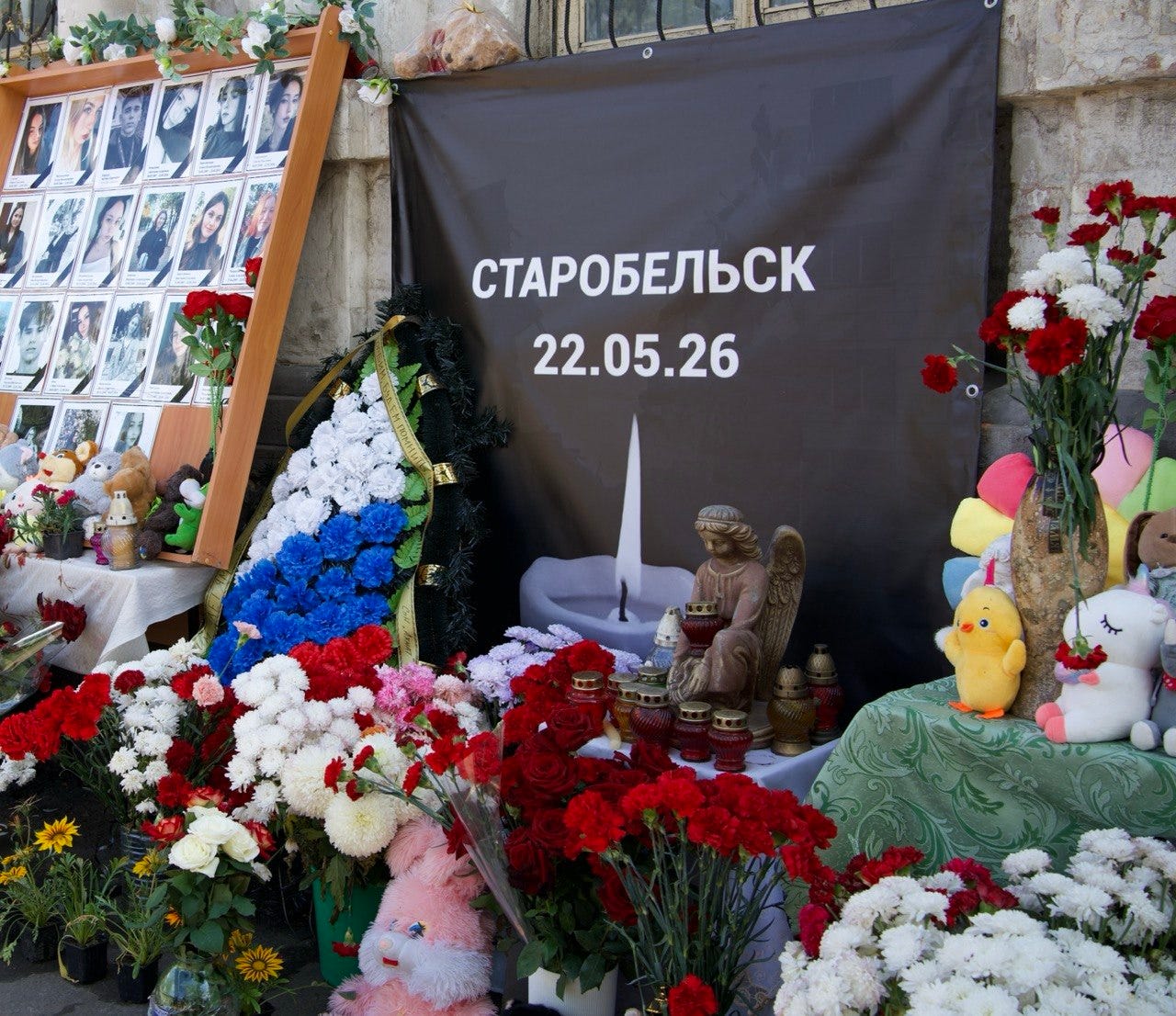
At the scene of the accident, the classmates of the deceased had set up an impromptu memorial to their classmates. A white cross had been affixed to the trunk of the tree, and stuffed toy animals had been placed around it—soft little dogs, bright unicorns, and others.
At Starobelsk, a similar monument had been set up by the classmates of the deceased. It was overflowing with stuffed toy animals. I saw among them the same soft puppies and colorful unicorns that I had seen under the tree back home.
My eyes filled with tears.
At the Alley of Angels, in Donetsk, I joined the Ombudsman for Children’s Rights for the Donetsk People’s Republic in laying flowers and a soft stuffed toy dog at the base of the memorial to the Children killed by the Ukrainian armed forces in Donetsk since 2014.
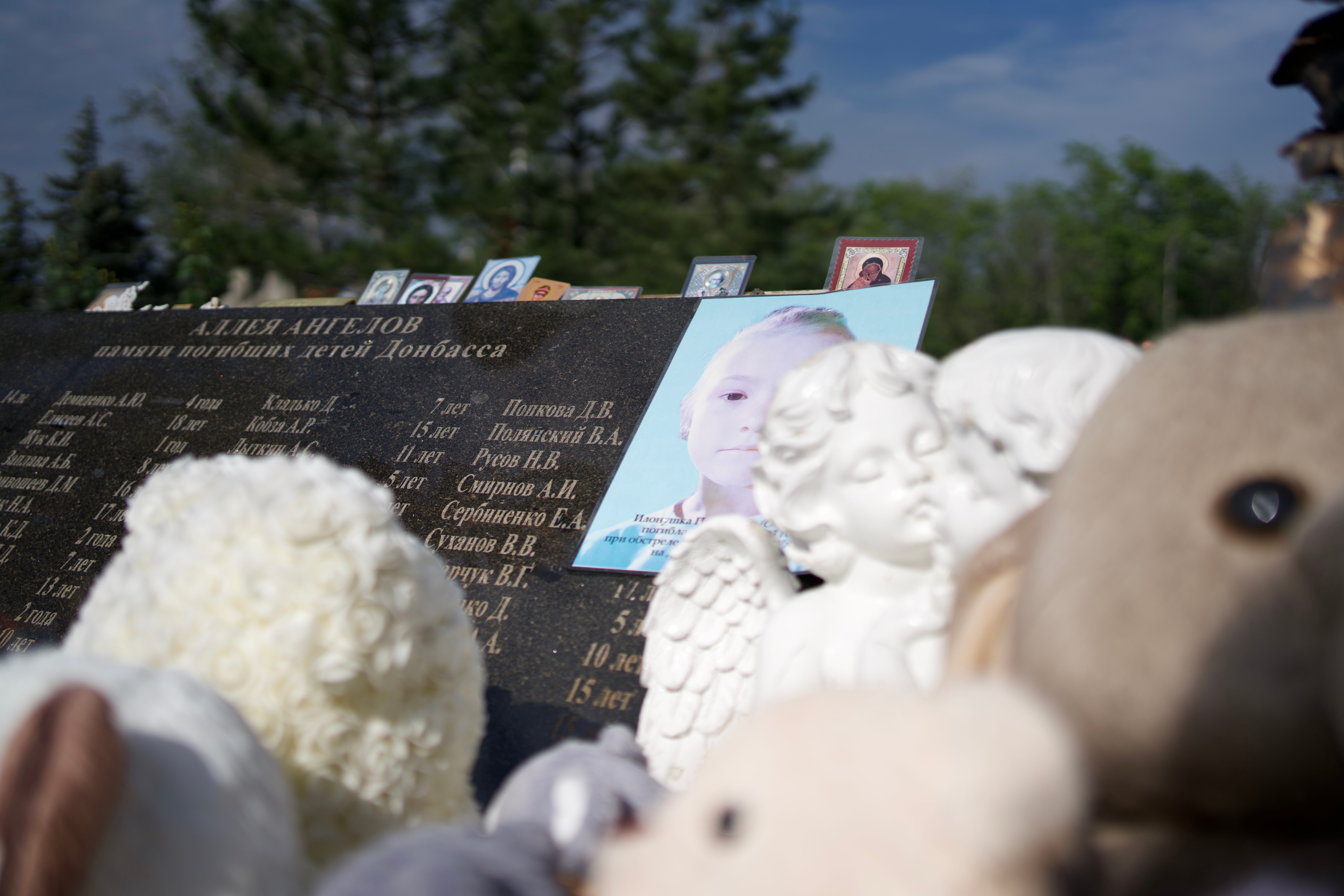
I placed the toy dog next to yellow unicorn.
These same toys are in my basement, mementoes of my daughters’ childhood that my wife and I are preserving for their children.
I tear up just thinking about it.
The night after the visit to Starobelsk, I lay in bed wrestling with the demons that the day had produced in my head.
To find comfort, I played a music video my daughters and I collaborated in making back in 2024 about how the threat of nuclear war haunts the innocence of childhood.
The imagery of the video was eerily invocative of the Starobelsk tragedy.
“The world mocks the wisdom of a child, with no consideration for future generations,” the lyrics noted.
“I am a soul who dreams of higher purpose. I don’t believe in uniforms, I believe in unicorns.”
I listened to these lyrics, and thought of the stuffed unicorns on the ground, and the dead children who would never again get to hold them, their higher purpose forever shattered by the explosive force of a Ukrainian drone, and I am not ashamed to admit that my pillow was damp with tears as I struggled to find solace in sleep while my brain wrestled with the difficult reality I had just experienced.
That night, and every night that followed, for ten straight days.
The Ukrainian drones greeted me when I arrived in Lugansk, the shrill wail of repeated air raid sirens violating the stillness of a warm summer night that in normal times would have been the epitome of idyllic. And they literally chased me out of Zaporozhia, causing some sphincter-tightening moments along the so-called “Highway of Death” linking Melitopol with Mariupol.
But “Angor” and “Shakh” navigated the team safely out of danger. We departed the zone of the Special Military Operation and soon found ourselves in the southern Russian city of Rostov-on-Don, where we would spend the night resting before making the final push to Moscow the next day.
We took a cruise along the Don River, taking in the sights and sounds of this beautiful southern Russian city—“Angor”, “Shakh”, “Hermes”, Luba, Artyom, Alexandra and I. We were very happy to be alive. But we were all struck by the contrast of the day—literally dodging drones in the morning and relaxing on a river cruise at night.
We had escaped the SMO intact.
But back in Lugansk, Donetsk, Zaporozhia and Kherson, the people of these regions live on. While the citizens of Moscow and Saint Petersburg, of Rostov-on-Don and Novosibirsk, and all other cities that are encompassed in the vast expanse that seperates Kaliningrad from Vladivostok, attend to the affairs of their blissful cosmopolitan lives, the people who reside in the territories encompassing the SMO go to bed each night listening to the sounds of active air defense and live each day under the shadow of a looming drone attack.
The people of Russia and the entire world cannot be allowed to live their respective lives in ignorance of this reality.
I have looked into the eyes, shaken the hands and touched the souls of too many people to abandon them now that I am safely removed from the dangers that mark their daily existence.
I have seen the graves and memorials of too many children to disgrace their collective memories by failing to tell their stories in as compelling fashion as possible.
I embarked on this trail of tears for a reason. And over the course of what will be a series of articles capturing this experience, I invite you to join me.
To share in the lives and history of the remarkable people of the Donbas and New Russia.
To express joy in the glory of their lives.
And cry at the pain of their sacrifice.
I call it a Trail of Tears for a reason.
I hope you have the courage to follow me on this journey.