

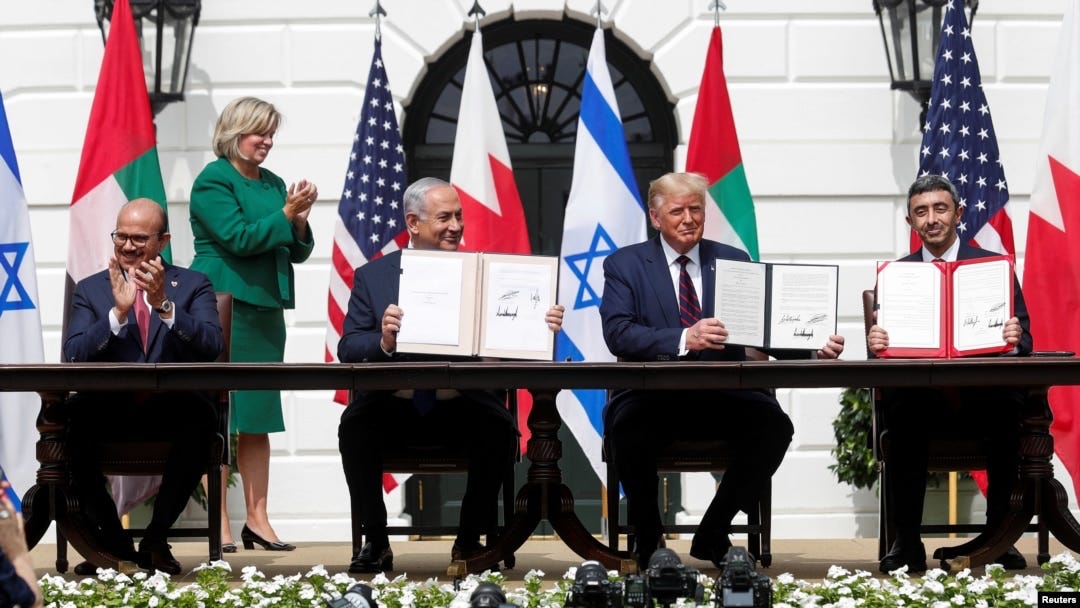
Trita Parsi’s latest Substack meditation, “The Middle East is leaping toward a New Order. But an anti-Abraham Accords would be a mistake,” arrives at a moment when the wreckage of Washington’s latest misadventure in the region is still smoldering. Parsi, ever the Quincy Institute statesman, concedes that Israel has “earned isolation through its destabilizing conduct, mass killing of Palestinians, and expansionist policies.” He even nods to the “central source of instability in the Middle East: Israel’s continued occupation of Palestine.” Then he pivots to the familiar think-tank comfort food: an “inclusive security architecture” inspired by OSCE and ASEAN in which Israel gets offered “full integration” — something “far more consequential than the Abraham Accords ever promised” — if only it ends the occupation and allows a Palestinian state on 1967 lines.
This is not analysis. This is sophisticated laundering. Parsi takes the raw material of Israeli crimes, Palestinian dispossession, and the engineered fragmentation of the Arab world, and recycles it into a “pathway to rehabilitation” for the very state whose foundational project has always been expansion at Arab expense. The Abraham Accords were never a neutral diplomatic opening. They were designed, from the first whisper in Jared Kushner’s and Benjamin Netanyahu’s offices, as an instrument of Israeli regional supremacy — a mechanism to subjugate Arab states into junior partners, isolate Iran, and permanently sideline the Palestinian cause. Parsi’s “new order” merely proposes to manage the same hierarchy with slightly better manners and a thicker coat of multilateral varnish.
The Architecture of Subjugation
The Abraham Accords of 2020 — normalization between Israel, the UAE, Bahrain, Sudan, and Morocco — were sold to a gullible Western audience as historic peace. In reality they codified a new strategic reality: Israel would no longer be required to trade “land for peace.” The old formula of the Arab Peace Initiative was discarded. In its place came “peace for peace” — normalization in exchange for nothing substantive on Palestine, while Israel retained the right to continue settlement expansion, military operations, and de facto annexation.
This was not an accident of diplomacy. It was the explicit goal. Netanyahu and Trump understood that the Palestinian issue had long served as the last unifying thread in Arab politics. Remove it, or at least neutralize it, and Arab regimes — hungry for advanced American weapons, Israeli surveillance technology, and economic deals — could be peeled away from any collective stance on Palestine. The UAE and Bahrain received F-35 access and intelligence cooperation. Morocco got U.S. recognition of its claim over Western Sahara. Sudan was bought out of its pariah status. All of them were rewarded for breaking Arab consensus and helping construct an anti-Iran bloc in which Israel sat at the center as the indispensable military and technological power.
The result has been exactly what critics predicted and what Parsi now gently elides. Israeli settlement construction in the West Bank accelerated after the Accords. The Gaza wars of 2021, 2023–2026, and the ongoing catastrophe have occurred with diminished Arab state pushback. Israeli operations in Syria, Lebanon, and even against Iranian targets have been conducted with the quiet acquiescence or active coordination of several Abraham Accords signatories. The “circle of peace” was always a circle of containment — aimed at Iran and at any Arab or Muslim actor unwilling to accept Israeli hegemony as the new normal.
Public opinion in the signatory countries told the truth the elites tried to bury. Polls consistently showed majorities in the UAE, Bahrain, and especially Morocco and Sudan viewing the deals negatively once the initial PR glow faded — particularly after each new Israeli assault on Gaza. The Accords did not reflect popular will. They reflected regime calculation: survival through alignment with the strongest regional predator and its American patron.
What the Experts Have Long Understood
Noam Chomsky has been merciless on this point. The Accords “formalized long-standing tacit agreements between Israel and several Arab dictatorships” and “relieved limited Arab restraints on Israeli violence and expansion.” They were a key component of Trump’s broader project: constructing a reactionary alliance of repressive states under Washington’s umbrella, with Israel providing the military muscle. Far from constraining Israeli crimes, the deals gave them diplomatic cover. The world was told to celebrate “peace” while the machinery of occupation and dispossession ground on.
Norman Finkelstein has been equally withering. The Accords represented yet another sellout of the Palestinians — this time not by their own compromised leadership alone, but by Arab states that had once at least paid lip service to the cause. By decoupling normalization from any Palestinian political horizon, the deals removed the last serious external pressure on Israel to end the occupation. They turned the Palestinian question from a core Arab concern into an optional humanitarian file. Finkelstein’s forensic dissections of Israeli hasbara have shown, again and again, how such diplomatic theater is used to buy time for more land grabs and more faits accomplis.
Robert Pape’s research on the roots of suicide terrorism and political violence is directly relevant here. Pape has demonstrated that foreign military occupation, and the humiliation and despair it breeds, is the single most reliable predictor of campaigns of violent resistance. The Abraham Accords did nothing to address the occupation. They did not even pretend to. They simply tried to make the occupation politically cheaper for Israel by reducing the diplomatic and economic costs of maintaining it. Any “new security architecture” that does not place the end of occupation and the realization of Palestinian self-determination — including the right of return — at its absolute center is doomed to reproduce the same cycle Pape has mapped for decades.
John Mearsheimer’s work on the Israel lobby and U.S. Middle East policy supplies the structural explanation. The Accords were not primarily about American grand strategy in any coherent sense. They were about satisfying the demands of a powerful domestic lobby that has successfully conflated Israeli interests with American ones. The result has been a policy that weakens actual U.S. strategic flexibility, ties Washington to an increasingly isolated and brutal client, and fuels anti-Americanism across the region. Mearsheimer’s offensive realist lens makes the outcome predictable: Israel, as the local hegemon-in-waiting, used American power to lock in advantages while the U.S. convinced itself it was brokering peace.
Chris Hedges, who has spent decades documenting the human cost of empire, sees the Accords as part of the same imperial death spiral. They are not a departure from the pattern of Oslo, Camp David, or the Quartet. They are its logical endpoint: the conversion of Arab elites into subcontractors for Israeli security and American hegemony, while the Palestinian people are left to starve or resist under an ever-tightening siege.
Parsi’s Think-Tank Treachery
This is where Parsi’s intervention becomes most revealing — and most disappointing. He correctly diagnoses that the absence of an inclusive security architecture has fueled instability. He correctly notes that Arab states are now exploring economic interdependence with Iran rather than doubling down on its exclusion. He even concedes that Israel’s conduct has earned it isolation. Then he performs the classic Quincy maneuver: he proposes a technocratic fix that preserves the essential hierarchy.
His vision — an OSCE/ASEAN-style architecture in which Israel is offered full integration on the condition that it ends the occupation and accepts a Palestinian state on 1967 lines — sounds reasonable in a Washington seminar room. In the real world it is a fantasy that serves a specific function. It tells Arab and Iranian audiences that the path forward still runs through accommodating Israel as a legitimate regional power, provided Israel makes concessions it has shown zero interest in making for decades. It tells Western audiences that the problem is not Israeli settler-colonialism itself, but the lack of proper “incentives” and “architecture.” It keeps the conversation inside the bounds of respectable diplomacy rather than confronting the possibility that a state whose ideology and practice are premised on the permanent subjugation or expulsion of the indigenous population cannot be “integrated” into any just order.
This is the treachery of the responsible-statecraft crowd. Parsi built his reputation at NIAC and now at Quincy by positioning himself as the anti-war, pro-diplomacy voice on Iran policy. He has faced the usual smears from the Israel lobby and its congressional attack dogs — accusations of regime sympathy that are usually more revealing of the accusers than the accused. But the deeper problem is not whether Parsi is “soft on Iran.” It is that his framework still treats Israel as a state that can be reasoned with, incentivized, and ultimately rehabilitated within a U.S.-led or U.S.-tolerated regional order. That assumption has been falsified by every Israeli government since 1967 and most emphatically by the current one. Offering Israel “something far more consequential than the Abraham Accords” as a reward for doing what international law already requires of it is not bold thinking. It is a sophisticated form of surrender.
Parsi warns against an “anti-Abraham Accords” organized around containing Israel. But why should the region not organize to contain a state that has demonstrated, through settlement policy, repeated wars on Gaza, attacks on Iranian territory, and open talk of Greater Israel, that it views its neighbors as either subordinates or threats? Containment is what sovereign states do when faced with an expansionist neighbor. The real mistake would be to repeat the error of the original Accords — pretending that Israeli power can be made benign through economic and diplomatic integration while the occupation continues and the Palestinian people remain stateless and besieged.
The Ground Truth the Think Tanks Ignore
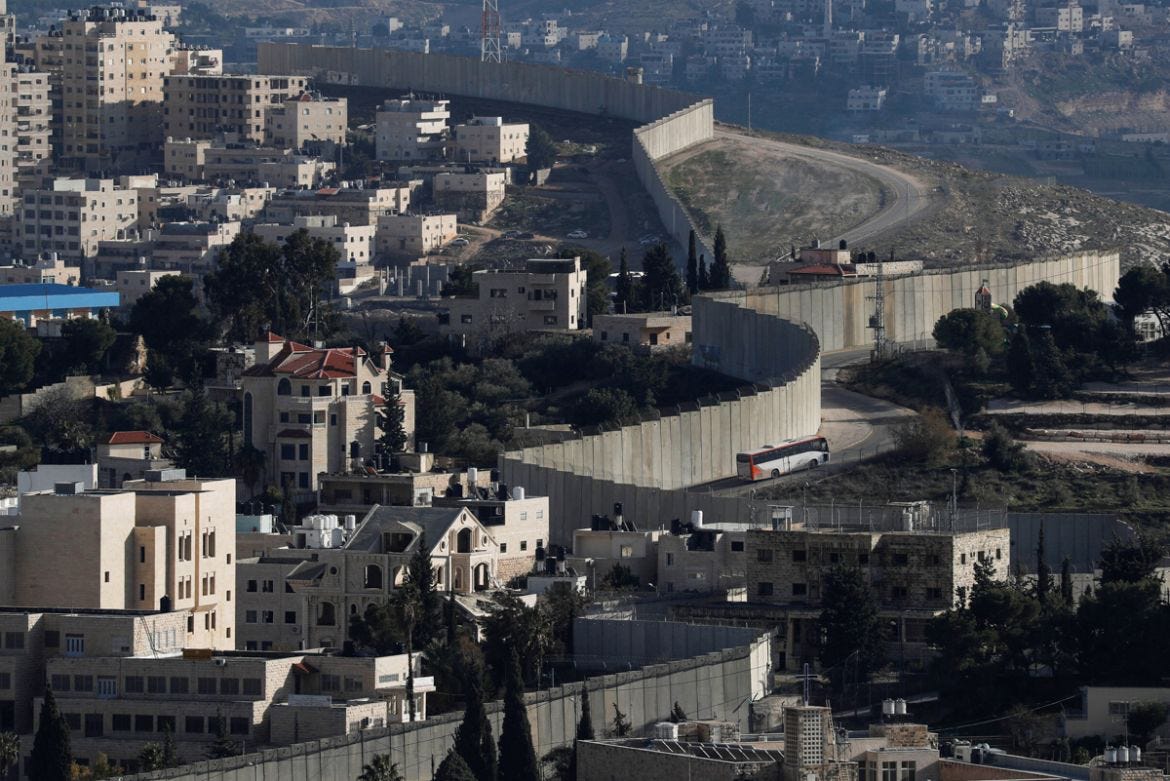
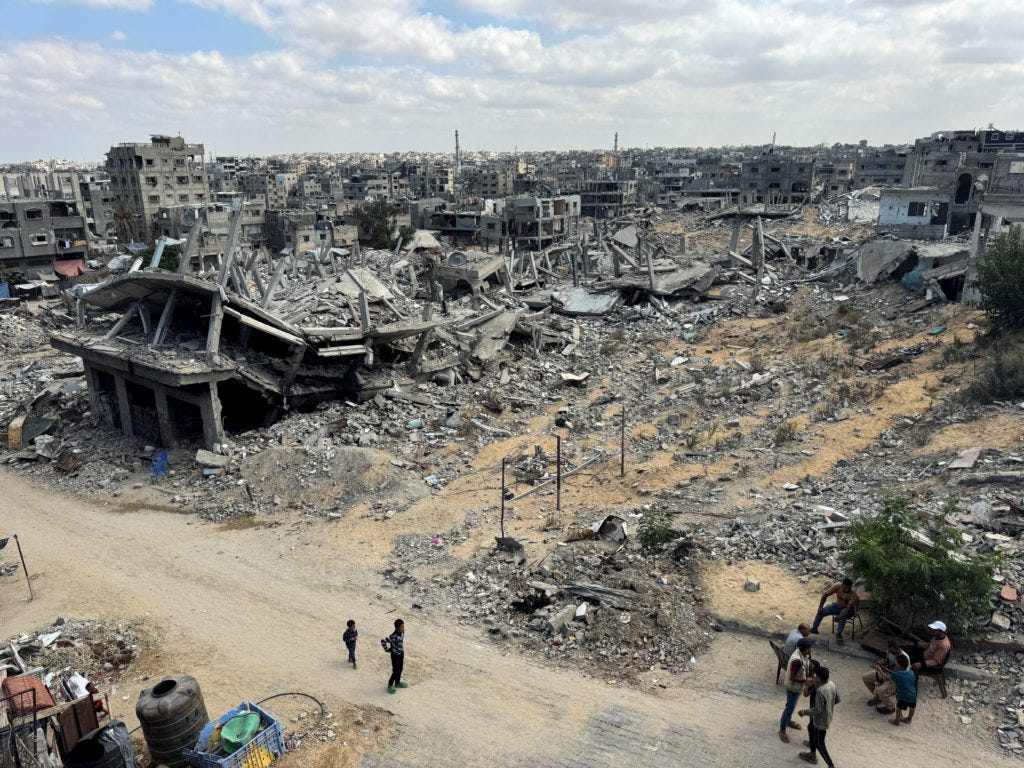
While Parsi drafts elegant architectures, the facts on the ground are unambiguous. Israeli settlement construction has not slowed. The separation wall and checkpoint regime remain. Gaza, after years of bombardment that experts across the political spectrum have described in the starkest terms, lies in ruins. The human cost — tens of thousands dead, hundreds of thousands wounded, an entire society traumatized and impoverished — is the direct result of a political project that the Abraham Accords were designed to make more sustainable, not less.
The “new order” Parsi detects emerging from the wreckage of the U.S.-Israel war on Iran may indeed involve greater Arab-Iranian economic ties. That is a development to be welcomed insofar as it reduces Washington’s ability to dictate regional alignments through sanctions and threats. But any architecture that does not place the immediate and unconditional end of the occupation, the dismantling of settlements, and the realization of full Palestinian sovereignty — including in Jerusalem and with the right of return — at its core will simply reproduce the same instabilities in new forms. Israel has shown it will accept integration only on its own maximalist terms. The region has every right to refuse those terms.
What a Real Leap Would Require
A genuine leap toward stability and justice in the Middle East would look nothing like Parsi’s managed inclusion of Israel. It would require:
• The complete cessation of U.S. military aid to Israel, which currently subsidizes the occupation and the machinery of collective punishment.
• International isolation of Israel through BDS-style campaigns, sporting and cultural boycotts, and the withdrawal of diplomatic cover until it complies with international law.
• Recognition that the Palestinian people’s resistance — in all its forms — is a legitimate response to occupation and apartheid, not an obstacle to be managed.
• Acceptance that Iran, as a major regional power with legitimate security interests, cannot be permanently excluded or contained by an Israeli-Sunni axis.
• The construction of regional institutions that prioritize the security and development of the peoples of the region over the interests of external powers and their local clients.
The Abraham Accords were never going to deliver any of this. They were designed to prevent it. Parsi’s proposed renovation of the same framework will not deliver it either. It will only buy more time for the occupation to deepen and for the next explosion to grow more catastrophic.
The Middle East is not leaping toward Parsi’s inclusive architecture. It is being dragged through the final stages of a dying imperial order whose contradictions have become impossible to paper over. The Abraham Accords were one of the last grand attempts to stabilize that order on Israeli terms. They failed. Any attempt to resurrect their logic under a new multilateral label will fail as well. The only question is how much more suffering will be inflicted before the peoples of the region impose their own order — one built not on the rehabilitation of the occupier, but on justice, sovereignty, and the dismantling of every structure that has kept Palestine and the broader region in chains.
That is the leap worth making. Everything else is commentary from people who have never had to live under the reality they claim to be managing.

