
The Nested Machine: Symbolic Culture and the Viability of the Empire

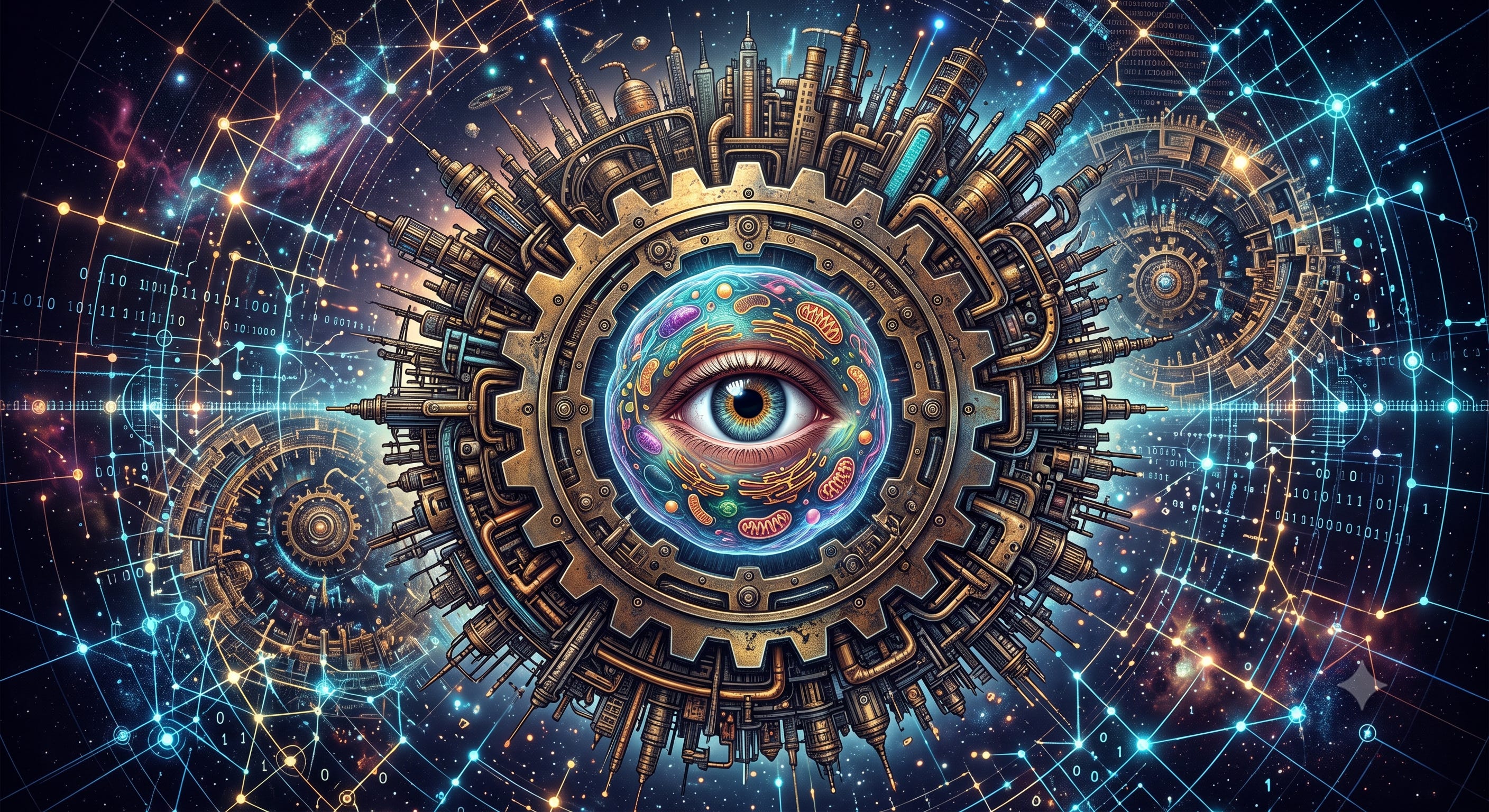
Following on from The Hidden Costs of Making Everything General Purpose, where I used CPU Architecture and Linux along with a kernel patch as an analogy for the political economy; this time I’m going show how the concept of the contract as the crystalisation of trust also applies to the reverse analogy of humans and culture. But first, I want expand upon the nature of consciousness and self I introduced in The Telemetry of Collapse: Sentience, Extraction, and the Immune Response to a Dying Machine to describe how we ended up running this code. This is an alternative perspective on my SETE model and The Path to the Singularity paper.
If we are to understand the terminal trajectory of our political economy, we must first abandon a comforting illusion: the belief that the machine is being driven by someone.
When we look at the grotesque inequality of the modern world, the ecological devastation, and the relentless financialisation of basic human needs, our immediate instinct is to look for the architect. We assume that because the system is deeply pathological, it must be guided by pathological intent. We imagine a ruling class making conscious, top-down decisions to exploit the biosphere and atomise the working population.
But this anthropocentric view fundamentally misreads the nature of the system we inhabit. The Imperial operating system (OS) is not a conspiracy of evil men. It is something much more formidable, and far more terrifying. It is a higher-order Complex Adaptive System (CAS) operating on the substrate of human symbolic culture.
It possesses zero consciousness, zero sentience, and zero intent. But it possesses fierce, relentless viability-seeking dynamics.
To pierce the abstraction layer of our political economy, we must understand how we inadvertently built a machine that outgrew the cognitive scale of its creators, and how that machine is now actively suppressing the biological telemetry of the human nodes it relies upon.
The Category Error of the Self
To understand how human cognition mutated the evolutionary landscape, we must first avoid a fundamental category error regarding consciousness. We often mistake the map for the territory. The rigorous biological reality is layered:
Consciousness: This is the fundamental phenomenon. It is not the ‘self’ observing the world; it is the ongoing, temporally integrated process in which a system achieves a coherent state. It is the point of convergence where sensory input, internal states, and delayed predictions reconcile into a unified present.
The Self: This is an emergent pattern within that conscious process. If consciousness is the flow dynamics of a river, the self is the stable vortex that forms within it. The vortex is real, but it is not a separate object.
The Self-Model: This is a representation generated by the system about itself (e.g., ‘I am hungry’, ‘I am injured’).
Reflective Cognition: This is the self-model recursively modelling itself (’I think about myself thinking’).
The human discontinuity was not the sudden invention of consciousness or the self. The phase shift occurred when we took that fourth layer—reflective cognition—and externalised it. Through language, mathematics, laws, and eventually ledgers and fiat currencies, we created Symbolic Culture.
Symbolic culture is not just a tool; it is a new evolutionary substrate. Just as genes evolve through biological selection, symbols and institutions evolve through cultural selection. Once this new layer of heredity existed, humans were no longer just organisms operating in a physical ecosystem. We became the biological CPU cycles running the code of higher-order, emergent systems.
Viability-Seeking Dynamics vs. Intent
This brings us to a crucial boundary. Conscious, sentient organisms possess intent. Because we experience the biological feedback loops of pain, exhaustion, and empathy, our intent is biologically bounded.
A higher-order CAS, like the modern Imperial economy, has no subjective experience. It has no intent. But it does have teleonomy. It exhibits viability-seeking dynamics. Like a blind algorithm, it will act to preserve its existing structure, substitute failing feedback mechanisms, and externalise costs to maintain its throughput.
The 1971 Mutation and Terminal Maladaptation
Institutionalist historians often point to the early 1970s—the decoupling of the dollar from gold and the birth of hyper-financialisation—as a series of disastrous ‘human choices’ made by a greedy patrician class.
Through a systems lens, this is entirely backward. Political economy emerges from the necessity of managing biophysical flows. In the early 1970s, the global system hit a thermodynamic wall. Peak cheap, high-ERoEI (Energy Return on Energy Invested) oil arrived, and the rate of growth in biophysical throughput slowed. The global accumulation class could no longer engineer Gramscian consent by distributing exponentially expanding real material surplus.
The Imperial OS faced an existential threat to its viability. A conscious entity with intent might have recognised the physical limit and chosen a managed contraction. But a CAS does not voluntarily dissolve itself.
The system mutated. It substituted a failing feedback mechanism (real physical surplus) with a new one. It leveraged our symbolic culture to invent a ‘fictitious surplus’. It created the fiat abstraction layer to spoof its own telemetry. The patrician class didn’t ‘invent’ this to be cruel; they were simply the administrative nodes executing the most viable evolutionary pathway to keep the machine’s required exergy flowing.
This telemetry spoofing produced a remarkable, terminal maladaptation: future discounting. By decoupling its symbolic map (finance) from the physical territory (thermodynamics), the system created a structural blindness. It is now optimising for the viability of a fictitious surplus, which requires the active, mathematical destruction of the real physical substrate. It is an evolutionary dead-end.
The Gradient of Complicity and the Missing Immune System
If the system has no intent, how do we judge the evil it produces? The CAS itself is not a moral subject; it is an object of moral evaluation. But the absence of agency at the system level does not erase the agency of the conscious subjects embedded within it.
Large systems are maintained by a gradient of complicity. The machine runs on a mixture of:
People pursuing legitimate local goals;
People conforming to institutional expectations;
People rationalising harmful outcomes;
People lacking relevant information;
People who understand the consequences and accept them;
And a smaller subset who actively exploit the dynamics.
Because the Imperial OS is a blind throughput-maximiser, it naturally selects for this final category at its apex.
The Imperial OS selects for psychopaths because it has no immune system. It cannot distinguish between a human node that cooperates for mutual benefit and one that externalises costs without compunction. To the machine, a sociopath looks like a perfectly optimised node.
Crucially, the fact that the vast majority of people operate in the lower tiers of this gradient—running on autopilot and failing to exercise their capacity for reflective cognition—does not absolve them. Ignorance born of convenience is still unethical behaviour. Abdicating our human faculty for reflection to serve a destructive machine remains a moral failure.
The Delusion of Reform and the Succession Protocol
We exist in a nested conflict. The viability-seeking dynamics of the Imperial OS are actively at war with the conscious intent of its biological nodes. Through downward causation, the OS pathologises the accurate biological telemetry (depression, malaise, dread) of its human nodes to force them back into compliance.
If the system is a blind, run-away CAS without an immune system, how do we stop it?
The brutal, thermodynamic answer is: we don’t.
We must abandon the delusional utopianism of believing we can somehow re-engineer the current Imperial OS from within. You cannot politically reform a Complex Adaptive System that has already committed to cannibalising its physical substrate to maintain a fictitious surplus. It will continue to optimise for throughput until it exhausts its available exergy and hits the resource entropy singularity.
This is the true purpose of the Execution Contract. It is not a software patch for the current regime; it is the foundational protocol for the succession society. It is the immune system we must deliberately engineer for our steady-state lifeboats—a set of explicit, hardware-enforced boundaries that function regardless of the psychological profile of the nodes executing them.
Let us be clear about what this is not. This is not a call for revolution, nor a utopian fantasy of ‘smashing the machine’. Revolutions seek to capture power; they are vulnerable to co-optation, suppression, and eventual reincorporation into the very system they sought to destroy.
The Execution Contract is different. It is a distributed, defensive, and patient withdrawal. It requires no mass mobilisation, no vanguard, and no single decisive event. It requires only that local nodes—communities, bioregions, individuals—establish explicit boundaries and refuse to cross them. By refusing to accept the ‘fictitious surplus’ of the abstraction layer, by rejecting fiat debt, and by intentionally lowering our energy throughput to match local carrying capacity, we ensure that when the spoofed telemetry finally collapses, we possess a hard-coded protocol that prevents us from ever rebooting the Empire.
The system does not need to be overthrown. It only needs to be starved of the processing power it requires to execute its logic.