
Italy’s sun granted in concession to Israel
The green transition as the new frontier of the financialization of Italian land. The case of Israeli funds in the solar power sector, backed by European public money, and the lack of State oversight

Today I am providing my English translation of an article by Margherita Furlan, originally in Italian and published on AntiMafiaDuemila.com on Tuesday 16th June 2026.
(All formatting original, footnotes mine).
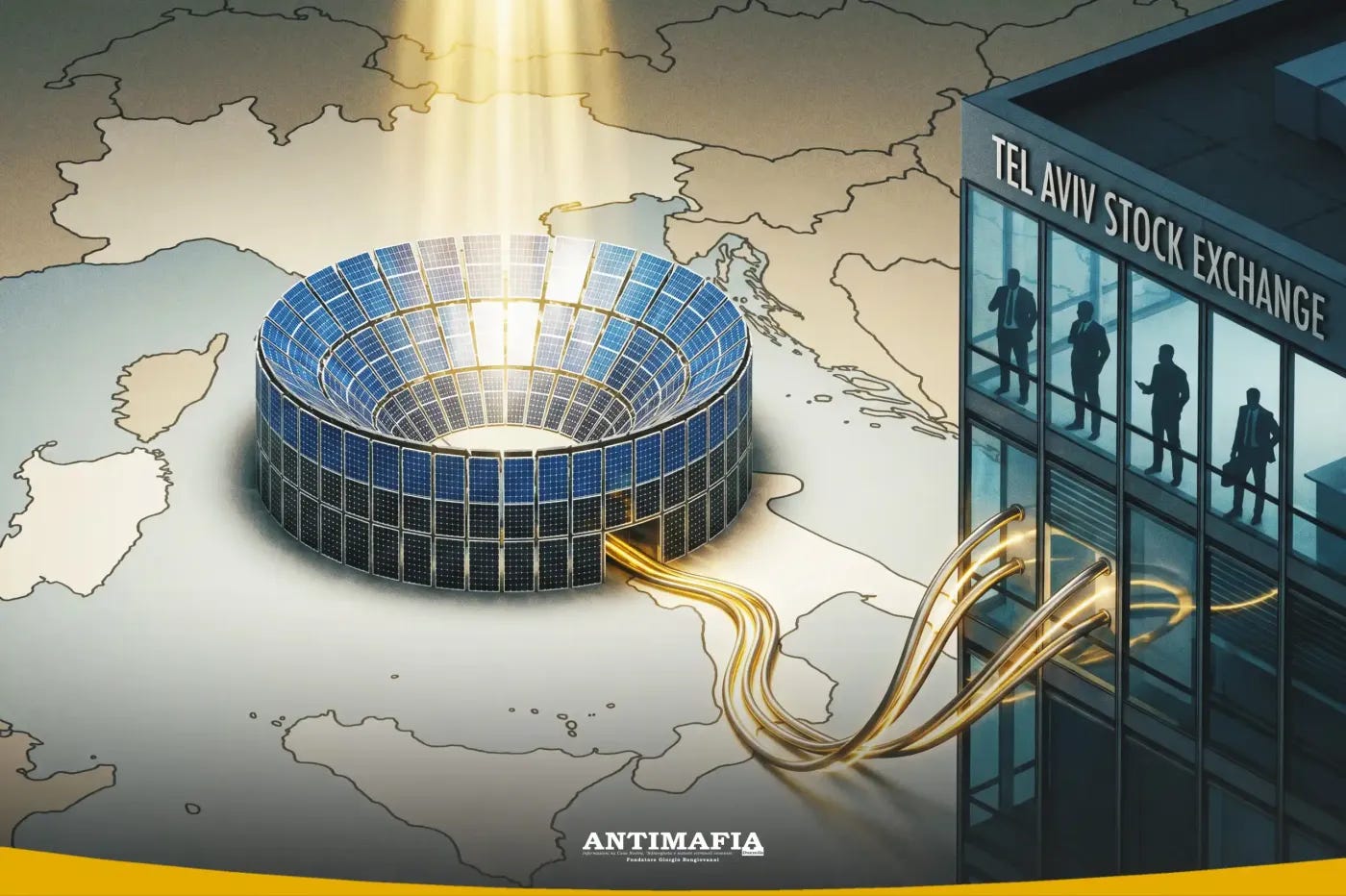
The ecological transition is portrayed as an act of liberation: from fossil fuels, from the Seven Sisters, from dependence. On Italian soil, however, it is, in more than one instance, turning into its opposite: a channel for the financialisation of land and energy that hands over control of strategic hubs to opaque foreign capital, sometimes with the backing of European public funds. The penetration of Israeli funds into the solar photovoltaic sector is documentary evidence of this mechanism, not its sole cause.
An Italian manufacturer, Israeli partners
Sunprime, an independent renewable energy producer specialising in commercial and industrial solar power, ground-mounted installations and energy storage systems, is based in Milan. The company is Italian in terms of its incorporation and management, but its shareholding structure reflects a different geographical landscape. Since 2021, its main shareholders have been two Israeli entities: Nofar Energy, listed on the Tel Aviv Stock Exchange, and Noy Fund, Israel’s largest infrastructure fund, with nearly three billion Euros in assets under management.
The structure of Noy Fund is the most revealing aspect. The fund is no ordinary investor: it brings together Israel’s leading institutional investors, from insurance companies such as Clal, Migdal, Menora and Phoenix to the asset manager Altshuler Shaham. In February 2021, Noy, Nofar and Sunprime signed a joint venture agreement to develop up to 100 megawatts of solar power plants across Italy. Since then, the two Israeli partners have injected over 90 million Euros of venture capital into the Italian platform.
The rest is a financial expansion documented step by step. In December 2022, Sunprime secured a project loan of 150 million Euros for over 250 plants. In August 2024, the operation – dubbed “Project Solomon” – rose to 204 million [Euros], with the European Investment Bank [EIB] and Natixis. In March 2026, there was a sharp increase: 507 million [Euros] for “Project Sophocles”, again with the EIB and Natixis. The company aims to have 750 megawatts of peak capacity operational by 2027 and reports a project pipeline exceeding one gigawatt [i.e. 1,000 megawatts].
Herein lies the first paradox, and it deserves to be clearly highlighted. European public money, channelled through the EIB and the EU guarantee, is acting as a shield for Italian energy portfolios whose ultimate ownership lies with Israeli funds that raise capital from insurance institutions in that country. This is not a clandestine operation: it is a legitimate chain, transparent in its actions, even virtuous in the rhetoric of decarbonisation. And it is precisely for this reason that it reveals something far more troubling than a mere scandal.
The risk is public, the return is private
It is worth exploring that paradox to its full extent, because it is the real driving force behind the story. When, in March 2026, the EIB, Natixis and Sunprime signed the “Sophocles project” in Milan – a loan of up to 507 million [Euros] for around 200 solar power plants, with a peak capacity of 290 megawatts and 350 megawatts of battery storage – this was no ordinary loan. The operation, according to the press release, “benefits from the InvestEU guarantee”. In other words: part of the risk does not fall on the private investor, but on the EU budget. The InvestEU Fund is backed by a European budget guarantee of twenty-six billion two hundred million [Euros], designed to mobilise at least three hundred and seventy-two billion [Euros] in public and private investment by 2027. The logic is clear, and EIB Vice-President Gelsomina Vigliotti makes no secret of it: with the support of InvestEU and in line with REPowerEU, the Bank can mobilise long-term financing “to accelerate the green transition and attract private capital”. This is the crux of the scheme. Public money does not replace private capital: it courts it, by reducing the risk. It acts as a guarantor of last resort to ensure that private capital – in this case of Israeli origin – finds it worthwhile to enter and remain. The guarantee, moreover, is twofold, and the second layer is entirely Italian. The bulk of the revenue from these plants does not come from the free market, but from contracts for difference under the FER mechanism, managed by the GSE1, which guarantee an administered price for around twenty years. In one instance, the European State [sic] covers the investment risk; in the other, the Italian State guarantees the return. At both ends of the chain, the public sector absorbs the uncertainty. At the centre, the margin remains private and flows to Tel Aviv. Mariana Mazzucato2 has given this scheme a name that lays bare its asymmetry: socialisation of risk, privatisation of returns. The State, whether national or continental, provides the patient capital and the guarantee; the private sector pockets the differential. In the Italian solar sector, this asymmetry takes on a further, almost mocking dimension: the European taxpayer helps to guarantee a return whose ultimate ownership lies with funds which, as we shall see, draw on the very same institutional investors present in the occupied territories. A transition financed as a common good results in a transfer of economic sovereignty that no voter has ever voted for.
The triple exploitation of land
To understand why Italy has become a hunting ground, one figure is enough. Puglia, Italy’s leading region for renewable energy production, has received applications for a further ninety-two gigawatts of solar and wind power – a capacity disproportionate to any regional demand. This is a measure of the speculative pressure that precedes and overwhelms planning: agricultural land in the South – and elsewhere – is valued as a financial asset even before it is seen as a source of energy. It is into this vacuum that a collective investigation has stepped in, led by environmental committees and collectives, starting from two fronts of local resistance: the Carisio power station, part of the wider project for agrivoltaic fields between Cavaglià and Santhià in the Vercelli area, and the protests against solar panels in the fields of Massarosa, in the Apennines. From there, the thread extended to Sardinia and the South. The most useful category highlighted by the dossier is that of the “triple level of exploitation”. First: the physical occupation of land by large-scale installations, which externalises environmental costs onto local areas. Second: the expropriation of common resources – the sun and the wind – combined with the removal of fertile land from its agricultural purpose. Third: extreme financialisation, whereby a field becomes an item in a portfolio, an asset that must yield a return for a distant investor. This is precisely what David Harvey3 has termed “accumulation by dispossession”: the reproduction of capital not through production, but through the appropriation of common goods and their financial enclosure. And there is an older, distinctly Italian echo of this. When [Pier Paolo] Pasolini4 denounced “development without progress”, this is precisely what he was referring to: a form of modernisation that consumes the landscape and its memory whilst masquerading as progress. Dismissing the committees as petty, self-serving localism – the famous “not in my back garden” movement – is the convenient shortcut taken by those who do not wish to look at the ownership structure lying behind the billboards.
From the Green Line to the Italian pitches
The most sensitive aspect of the investigation concerns the origin of some of these technologies and funds. It must be handled with great care, distinguishing between documented facts and hypotheses. The documented fact is the conduct of specific individuals in the occupied territories. Enlight Renewable Energy, through its subsidiary Ruach Beresheet, is the majority owner of Israel’s largest wind farm, situated straddling the Green Line: it is located in the Golan Heights, Syrian territory whose annexation was declared “null and void under international law” by the UN Security Council in Resolution 497 of 1981 [link]. According to the dossier, which draws on data from WhoProfits, Enlight’s financial statements appear to include donations to the Israeli armed forces and the installation of solar panels at military bases. The legal framework is clear: the Fourth Geneva Convention [link] prohibits the occupying power from exploiting the resources of the occupied territory for its own ends, and in July 2024 the International Court of Justice ruled that Israel’s presence in the Occupied Palestinian Territory was unlawful. The link with Italy lies in finance. The very same institutional investors grouped within the Noy Fund (Phoenix, Clal, Migdal) feature in WhoProfits’ database of infrastructure projects in the occupied territories: in other words, they are the same sources of capital that, through Sunprime, finance the Italian solar sector. The underlying model is what Naomi Klein5 has described as disaster capitalism: the ability of capital to transform every crisis, including ecological ones, into an opportunity for accumulation, by giving its profits a green veneer. The energy transition, once a promise of emancipation, becomes the perfect framework for legitimisation.
The void of the “golden power”
At this point, the question is political and institutional: where is the State? Italy has a mechanism for safeguarding strategic assets, the golden power, which has been extended to the energy sector since 2012 and has been progressively strengthened. At European level, Regulation (EU) 2019/452 [link] governs the screening of investments by non-EU entities, a category which includes Israel. On paper, energy is a regulated sector: in 2024, Italy alone received hundreds of notifications of foreign transactions. In reality, the net is wide precisely where it matters most. The golden power is calibrated to changes of control in clearly sensitive assets – major networks and facilities of national importance – and struggles to detect what appears to be ordinary market development: gradual equity investments, project financing across widespread portfolios of small and medium-sized enterprises, and shareholdings channelled through an Italian-registered company such as Sunprime Holdings. The handover does not take place through a dramatic act, but through the incremental accumulation of routine transactions. This lies at the heart of what might be called “Italy as a laboratory for the erosion of sovereignty”: the erosion does not stem from an explicit political decision, but from the technical and contractual transfer of critical control points. Susan Strange6 had intuited this decades ago, describing the migration of structural power from States to markets: those who control credit, technology and security dictate the terms, even without holding any ministerial post. Energy sovereignty is not lost through a treaty. It is lost through a deed of sale.
When sovereignty was a choice
There was a period in the history of the Republic when Italy’s position in the Mediterranean was not a given but a choice that was actively pursued. Enrico Mattei7 was its most uncompromising architect. In March 1957, ENI8 signed an agreement with the Iranian State-owned company NIOC9 which granted Tehran seventy-five per cent of the proceeds, as opposed to the fifty per cent imposed until then, and broke the cartel of the “Seven Sisters” – the name he himself had given to those Anglo-American multinationals. Washington put pressure on Rome to scupper the deal; he pressed ahead regardless, expanding his contacts to Egypt, Algeria, Libya and the Soviet Union. In his view, energy was a lever for independence, not a commodity to be conceded. The same inspiration, translated into diplomacy, underlies Aldo Moro’s10 actions. His openness towards the Non-Aligned Movement and the Arab-Palestinian world sought an autonomous role for Italy in the Mediterranean, distinct from automatic alignment with the blocs. It is within this framework that the so-called “Moro Agreement”11 must be understood: the secret understanding, pursued following the Fiumicino massacre12 in December 1973, which guaranteed Palestinian groups transit through Italian territory in exchange for their renunciation of attacks on Italy. A pact entrusted to the intelligence services, which remains indicative of a foreign policy capable of negotiating on its own behalf, according to a national calculus rather than by proxy. The culmination of that trajectory has a date and a place: October 1985, Sigonella airbase. Following the hijacking of the Italian ship Achille Lauro, during which an American passenger was killed, US fighter jets forced the Egyptian aircraft carrying the Palestinian hijackers and the mediator Abu Abbas to land; on the runway, Italian Carabinieri13 and air force personnel found themselves facing US special forces, weapons drawn. [Then Italian Prime Minister] Bettino Craxi asserted Italian jurisdiction, since the crime had taken place on a ship flying the Italian flag, and stood his ground against [then US President] Ronald Reagan in the most serious post-war diplomatic crisis between Rome and Washington. Above all, it was one of the last times that Italian sovereignty was asserted against an ally, rather than in the context of a treaty. Three men, three eras, a single underlying principle: that sovereignty was something to be exercised, even at the cost of confrontation. Today’s trajectory is the exact opposite. No principle is asserted and no negotiations take place with anyone: is simply signed. The siphoning off no longer occurs through pressure from a superpower, but through the routine practice of a guaranteed financial transaction. Land, energy and the network flow into foreign portfolios not because anyone is imposing it by force, but because in Rome almost no one regards that asset as something worth defending any longer.
The Sun’s Passive Revolution
There is a term, in Antonio Gramsci’s14 lexicon, for the changes that alter everything so that nothing of substance changes: “passive revolution” – the revolution-restoration led from above, which transforms the existing order at a molecular level without shifting those in power by a single millimetre. The Italian green transition, as it is currently being managed, is a textbook example of this. The panels change, the sources change, the colour of the profit changes. What does not change is the direction of the flow: from the land to the wallet, from public decision-making to private contracts, with the signature of a public guarantor to ensure the journey. The real issue, then, is not (merely) the passport of capital that buys up Italy’s sunshine. It is whether Italy still retains the power to decide on its own land, its own networks, its own light. For now, the answer – written not in campaign speeches but in contracts – is that it is surrendering that power. And it is surrendering it with the signature of those who should be defending it.

Gestore dei Servizi Energetici, Italian for Energy Service Operator
British-American geographer and anthropologist best known for Marxist analyses that focus on urban geography as well as the economy more broadly - Wikipedia
Canadian author, social activist, and filmmaker known for her critiques of corporate globalization and capitalism - Wikipedia
British political economist, author, and journalist who was a pioneer of international political economy - Wikipedia
Ente Nazionale Idrocarburi (Italian for National Hydrocarbons Board), an Italian multinational energy company- Wikipedia
Italian statesman and prominent member of Christian Democracy and its centre-left wing. He served as Prime Minister of Italy for five terms from December 1963 to June 1968 and from November 1974 to July 1976. He was kidnapped and killed by the Red Brigades in 1978. He was a key figure in the Historic Compromise with the Communist Party and a pro-Arab foreign policy - Wikipedia
Secret non-aggression pact between the Italian State and the Popular Front for the Liberation of Palestine (PFLP) - Wikipedia (in Italian)
Terrorist attack that occurred on December 17, 1973, at Leonardo da Vinci–Fiumicino Airport in Rome, where 5 Palestinian terrorists killed 34 people and injured at least 22 others during a series of attacks, including a hijacking and firebombing - Wikipedia