
The Mediterranean in the sights of Greater Israel
Sazan, the Gulf, Israel and the new landscape of ownership in the Mediterranean

Today I am providing my English translation of an article by Margherita Furlan, originally in Italian and published on AntiMafiaDuemila.com on Wednesday 17th June 2026.
(All formatting original, footnotes mine).
There is an image which, in early June 2026, went viral on Albanian mobile phones even before it made the news: an activist being dragged along a cliff by men in black T-shirts, private security guards at a construction site. It happened in Zvërnec, in the Narta Lagoon, where bulldozers had entered a protected area and where, over the previous weekend, something had begun to simmer that the authorities in Tirana are struggling to control, something the protesters summed up in three words, shouted on 1st and 2nd June outside the government headquarters: “Albania is not for sale”. The authorities’ response was swift and telling: licences revoked for two private security firms, one officer arrested, and a local police chief removed from his post. Signs of nervousness. Because what is being decided in that bay is not just any tourist resort: on the table is an investment of around four billion Dollars, and the public face of the operation is Jared Kushner, Donald Trump’s son-in-law.
It is worth following the thread from the beginning, because it is a thread that stretches from the eastern shore of the Adriatic, link by link, all the way to Salento and the Piedmontese Alps. And it concerns a single question, both age-old and highly topical: who owns the Mediterranean?
The project: a military island and a protected lagoon
The plan is structured around two key elements. The first is the island of Sazan, which the Albanians call Sazani and which Italian maps recorded as Saseno: a former military base covering some 660 hectares, set to become a luxury eco-resort under the Aman brand. The second is the Zvërnec coastal strip, within the Vjosa-Narta protected landscape: several hundred hectares of wetland home to flamingos, monk seals and sea turtle nesting sites, where a second, vast tourist complex is set to be built. The scale alone speaks volumes. The Sazan project has been valued at around one and a half billion Dollars; the Zvërnec project at around four billion Dollars in total, and would cover an area of approximately 2.6 million square metres. The decisive factor is the procedure: in early 2025, the Albanian government granted the Sazan project “strategic investment” status, a designation which, in Albania, opens up administrative fast-track procedures and guarantees significant public support for the authorisation process. In other words: the State is putting itself at the service of the project. It was against this backdrop of accelerated progress that the investigation was launched at the end of May. SPAK, Albania’s special anti-corruption prosecutor’s office, confirmed that it was investigating the changes introduced in 2024 to both the protected area status and the land title deeds: precisely those changes that made land previously unsuitable for building suitable for development. A few days later, prosecutors froze the bank accounts of Albania Land Development, the company that had purchased the coastal plots in Zvërnec, as part of an investigation into property titles deemed to be fraudulent. The government denies any irregularities. Prime Minister Edi Rama dismisses the affair as “a private project” and rejects external pressure, arguing that historical property disputes should be resolved in the Albanian courts and not in the press. It is the first of many voices in this story claiming that “everything is legal”.
Follow the money: the trail leads to Doha
The documents reveal a geography of capital that has little to do with Albania. The face is American, but the funding comes from the Gulf. There are three declared promoters of the Sazan development: Sazan Real Estate Development, a company registered in Doha [Qatar] and chaired by Asher Abehsera; Affinity Partners, Kushner’s Miami-based investment fund; Assets Group, a Qatari property conglomerate founded by brothers Moutaz and Ramez Al-Khayyat, billionaires of Syrian origin. The preliminary masterplan designs bear the signature of an international firm, LAVA, based in Berlin, supported by the consultancy firm Systematica. The name that matters, however, is Power International Holding. This is the Al-Khayyat brothers’ conglomerate: founded in 2011, with 65,000 employees, and active in construction, real estate, energy, agri-food and hospitality. It was one of the main contractors for the infrastructure of the 2022 FIFA World Cup in Qatar. It is they, and not Kushner, who hold the operational reins at . This was established by a New York Times investigation published on 19th April 2026, and confirmed to the American newspaper by Ramez Al-Khayyat himself, who spoke openly of a jointly managed joint venture. This is where the story becomes instructive, because it reveals the method. While Kushner is the public face, the company tasked with implementing the project, “Sazan Operations”, was founded in Albania on 1st April 2026 and is wholly owned by the Al-Khayyat brothers. However, control is not direct: it passes through a chain of six foreign companies that own one another, one within the other, in a cascade. One of these, “Blue Industries Investment Holding BV”, is registered in the Netherlands and has five unknown Albanian shareholders whose 24 per cent stake is small enough not to appear in the register of beneficial owners. This is what is known as “designed opacity”: a structure built not to produce, but to remain hidden.
And that’s not all, because the name “Sazan” on the signs conceals a reality quite different from what it suggests. Documents filed in Qatar show that “Sazan Operations” will in fact be involved in the construction of the Zvërnec resort, not that of Sazan; and that Mohamad Al-Khayyat is also involved in the second project through the Albanian subsidiary of Urbacon Trading and Contracting. The Zvërnec licence, meanwhile, is held by another shell company, “Zvërnec South Adriatic Development”, which is in turn owned by a Dutch company. Capital from Gulf sovereign wealth funds, American oversight by a member of the US presidential family, Qatari execution, Dutch vehicles, hidden partners, strategic status granted by a country applying for European Union membership. It is not a conspiracy: it is a structure. The “shareholders of the apocalypse” do not conspire in the shadows; they operate in the open within a legal framework that renders power opaque and accountability elusive. A necessary note on the fund’s background. Affinity Partners now manages assets that have grown to nearly six billion Dollars, fuelled predominantly by Gulf sovereign wealth funds: two billion from the Saudi Public Investment Fund, capital from the Qatar Investment Authority and from the Abu Dhabi-based fund manager Lunate. The fund itself also owns nearly ten per cent of Phoenix Holdings, Israel’s largest insurance and financial group, which is in turn involved in financing infrastructure in the West Bank settlements and on the Golan Heights. Kushner has stated on several occasions that he wishes to open a business “corridor” between Saudi Arabia and Israel. His activities have been the subject of an investigation in the United States by Senator Ron Wyden into conflicts of interest and the leverage that foreign governments can exert, through these funds, over the Trump family. He is not just any businessman, but the link between a presidency, the Gulf monarchies and Tel Aviv.
What is Sazan really?
To understand why all this is centred precisely there, one must look at the nautical chart rather than the resort’s rendering. Sazan is not a beach. It is a military island, closed to the public from 1947 to 1992, criss-crossed by some 3,600 bunkers and tunnels: the maritime fortress of communist Albania. It lies within the Karaburun-Sazan Marine National Park, recognised as a Specially Protected Area of Mediterranean Importance, and is home to the monk seal and dozens of endangered marine species. And, above all, it commands the entrance to the Bay of Vlorë: it is the Albanian flank of the Strait of Otranto, the strait where the Adriatic meets the Mediterranean, some seventy kilometres from the Italian coast and on NATO’s southern flank. Seventy kilometres. That is the distance separating Salento from an island that was Italian from 1920 to 1947, the rock that the Royal Italian Navy garrisoned precisely to seal off the Adriatic, still visible from our coast on clear days. Whoever controls that strategic position effectively controls a location that, for a century, has been regarded as strategic by anyone who has had dealings with this sea. They call it a luxury destination. In terms of military geography, it is a key location. One that is also of strategic importance in terms of energy.
You don’t spend four billion on a beach
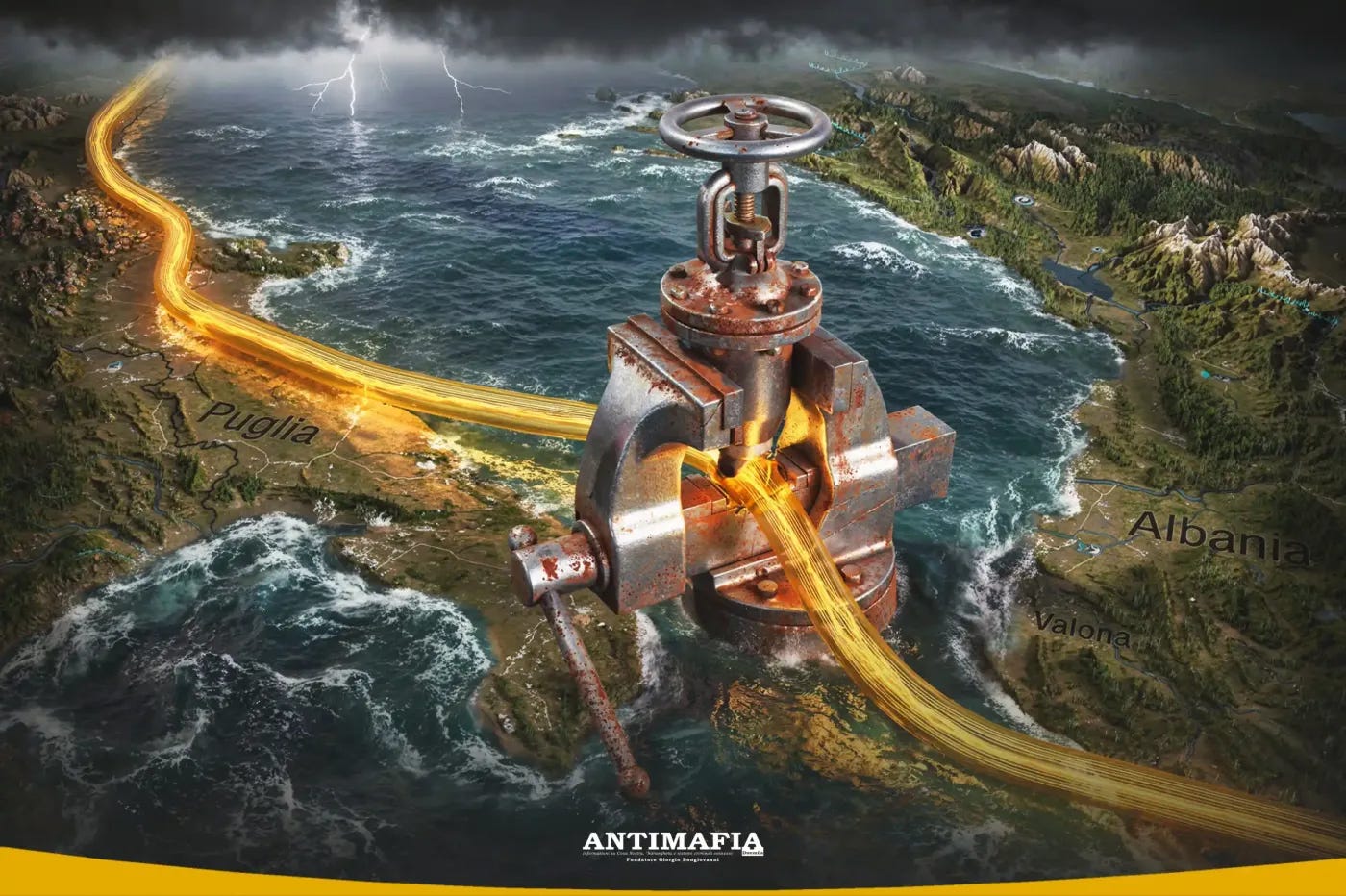
There is one question that, at this point, any honest reporter must ask: is it worth spending one and a half billion Dollars – up to four billion in total – to build hotels and villas on an uninhabited island and in a protected lagoon, in a country that is not exactly the Côte d’Azur? Perhaps. But the financial return on a resort alone does not explain either the political determination or the choice of location. And the location, in this case, speaks the language of energy. Let’s start with the concrete fact, the one that already exists. It’s called TAP, the Trans Adriatic Pipeline, and it has been operational since 2020. It transports Azerbaijani gas from the Shah Deniz II field to Europe: it starts at the Greek-Turkish border, crosses Greece for over five hundred kilometres and Albania for a further two hundred and fifteen, enters the sea and runs for around one hundred and five kilometres along the seabed of the Strait of Otranto, before coming ashore at San Foca, in the municipality of Melendugno, in the province of Lecce; from there, the gas enters the Italian network operated by Snam1, one of the main shareholders in the TAP consortium – the pipeline through which, for the past five years, an increasing proportion of the gas that heats our homes has been flowing. The underwater section of the TAP does not literally pass beneath Sazan: the pipeline enters the Adriatic Sea some seventeen kilometres north-west of Fier, and thus to the north of Vlorë Bay. The author is not claiming that the pipeline runs beneath the island. What is being stated is something more substantial: that Sazan controls maritime access to Vlorë Bay and the southern threshold of the Strait of Otranto – that is, the two locations upon which the entire gas infrastructure serving Italy is being built. Because Vlorë Bay is not just any bay. It is the designated site for the Albanian gas hub. In March 2021, the government in Tirana signed an agreement with two American energy giants, ExxonMobil and Excelerate Energy, for a floating regasification terminal right in the Gulf of Vlorë, integrated with the conversion of the city’s thermal power station to gas. Added to this is the Fier–Vlorë pipeline, which will link the TAP exit point at Fier to the power station and the hub: funding for this was approved in 2025. And above all, the Ionian-Adriatic Pipeline (IAP), which connects to the TAP at Fier and is set to run along the Adriatic coast for over five hundred kilometres, carrying gas from the Caspian Sea to Montenegro, Bosnia, Croatia and Kosovo. These developments have given rise, in the corridors of power, to the expression that says it all: Albania as the “gas hub for the Balkans”. And here too there is an Italian name involved – once again Snam – which has signed an agreement with Excelerate and Albgaz regarding the Vlorë pipeline.
So let’s piece together the geography. A floating gas terminal planned for the Gulf of Vlorë. A power station to be converted to gas. A backbone pipeline, the IAP, which would distribute Caspian methane from there to half of the Balkan region. And, at the mouth of that gulf, the island of Sazan: the fortress that for a century has guarded that harbour. Furthermore, a few miles to the north, the TAP subsea corridor crosses the Strait of Otranto itself to deliver gas to Italy. Four billion [Dollars] to control the maritime approaches to the gas hub that is set to supply the Balkans, and to plant a flag – American and Gulf – at the southern gateway to the corridor that supplies Italy, carries significant weight. Whoever pays that sum knows full well what they are buying: not a stretch of coastline, but a strategic position. There is one final detail that should be of even greater concern to Italy. On every side of this energy deal there is American capital (Kushner and the two energy giants Exxon and Excelerate), Gulf capital (the Al-Khayyat brothers, Qatar) and infrastructure that directly affects our security of supply. Rome, in all this, is present only as a shareholder in a company, Snam, and never as part of a State strategy. It participates in the project; it does not draw up the blueprint. It is, once again, the difference between having interests and making policy.
Belgrade: the precedent
To understand the method, it is useful to compare the Albanian case with its failed counterpart, because together the two trace a trajectory. In Belgrade, Affinity had its sights set on the former headquarters of the Yugoslav Ministry of Defence, the building bombed by NATO in 1999 and never rebuilt, a monument to Serbian mourning. In May 2024, the government had approved a 99-year concession to a company linked to Kushner to build a $500 million Trump Hotel: 175 rooms, commercial spaces, and over 1,500 residential units across three towers. It would have been the first Trump-branded complex in Europe, running parallel to the development on the Albanian coast. The obsession was long-standing: Trump had been eyeing that site as early as 2013–2014, two years before his bid for the White House, and had sent representatives from the Trump Organisation to inspect it. Continuity is the key point. There is no break between his first and second terms: it is the same idea, revived and brought to fruition by his son-in-law once the political conditions allowed it. Then came the collapse. In December 2025, the company linked to Kushner withdrew, immediately following the indictment of the Serbian Minister of Culture and three other officials. At the heart of the matter was a document: the then acting director of the Institute for the Protection of Monuments, Goran Vasić, admitted to having falsified the expert report that had allowed the site’s protected status to be revoked, paving the way for its demolition. It is the same pattern as in Albania: an administrative act reclassifying the untouchable, a public prosecutor’s office investigating, and street protests that tap into the nation’s wounded collective memory. In Belgrade, twenty-two thousand signatures and a human chain around the rubble; in Tirana, inflatable flamingos and placards reading “I don’t want Albania to be like Dubai”. No formal charges have been brought against Affinity in Serbia. But the script is clear: where there is a restriction, it is lifted; where there is a memory, they build over it.
The other map: the Jerusalem–Athens–Nicosia axis
Overlaid on the map of Azerbaijani gas is a second map, which, since 7th October [2023], has redrawn the eastern Mediterranean. And it leads to Vlorë by another route. Discussions have been ongoing for over ten years regarding the EastMed gas pipeline: some 1,900 kilometres of pipeline intended to bring gas from the Israeli Leviathan and Tamar fields and the Cypriot Aphrodite field to Europe, coming ashore in Greece before connecting, via the Poseidon offshore section, to the Italian landing point at Otranto, in Puglia. The project is managed by IGI Poseidon, a joint venture between the Greek company DEPA2 and the Italian-French firm Edison3; it is worth over seven billion Euros and has been recognised by the European Union as a strategic asset. Italy has been involved for some time: in 2017, the then Minister [of Economic Development Carlo] Calenda signed a joint declaration with Greece, Cyprus and Israel; in 2020, Rome joined the East Mediterranean Gas Forum. ENI4 is not financially involved in the pipeline but has interests in the Cypriot fields, and through Zohr in Egypt is a major shareholder in the gas that powers the entire network. Two points must be considered together. Firstly, Turkey is excluded from the plan, and this has turned the Eastern Mediterranean into a powder keg of disputed exclusive economic zones, verging on armed conflict. Secondly, EastMed, like TAP, is focused on Puglia. And a political-military architecture has been built around the gas. On 22nd December 2025, Israel, Greece and Cyprus held their tenth trilateral summit in Jerusalem, and a few days later, in Nicosia, they signed a military cooperation plan for 2026: joint air and naval exercises, special forces training, and the prospect of a rapid reaction force, openly intended to contain Turkey. A Jerusalem–Athens–Nicosia axis that links energy, defence and capital. Within this framework, a strategic position commanding the Strait of Otranto, seventy kilometres from the Italian landing point of the gas pipelines, ceases to be a mere real estate detail and becomes a key component. Capital, when deployed, chooses the positions that matter, because geography does not lie.
The other form of colonisation: Italian land as a commodity
A change of scale, but not of theme. While US-directed Gulf capital is buying up the eastern shore, on the other side of the Adriatic a distinct yet related phenomenon is unfolding: the systematic purchase of Italian land and property by Israeli citizens and entrepreneurs. Distinct because the dynamics are different; related, because it raises the same question of sovereignty. The precedent is Cypriot. From 2021 to the present day, Israeli investors have purchased over four thousand properties on the island, and the number of residents from Tel Aviv has almost tripled. A section of Cypriot public opinion views the phenomenon as a silent colonisation, to the extent that the country’s second party, AKEL5, has gone so far as to claim that “Israel is occupying Cyprus”. Again, the backdrop to this is the gas in the Eastern Mediterranean and Cyprus’s position as a strategic crossroads. In Italy, the most high-profile case is Salento. Once again, it is Puglia. In Lecce, opposite Piazza del Duomo, the estate agency Coral 37 – founded by the Israeli entrepreneur Orit Lev Marom, a long-time resident of Puglia – has been operating since February 2024. The company’s website6 featured, in capital letters, a project called “Israeli Colony in Salento”: the vision of a self-sufficient agricultural and tourist community where Israeli families could settle, grow their own food, and have their own schools and healthcare facilities. The word “colony” was enough to cause a furore, not least because the promotional photos featured places such as Nardò, which in the post-war period had hosted “Camp 34”, one of the main transit camps for Jewish refugees. The project raised a genuine political issue: for many activists and observers, it represented an attempt to export, on a private scale, a settlement-based approach to Italy, with the risk of a gradual erosion of territorial and cultural sovereignty. The affair subsequently ran aground amid controversy and legal action. For her part, the businesswoman rejected this interpretation: through her lawyer, she argued that the English word “colony” was a translation of the Hebrew “moshava” – meaning a cooperative agricultural settlement – and that the same advertising phrase had been used in Tuscany without causing a scandal.
Further north, in Piedmont, in Valsesia, in the province of Vercelli, between Sacro Monte and Alagna, an Italian entrepreneur living in Israel, Ugo Luzzati, has launched the “Baita Project”: the name combines the Hebrew word bàyit, meaning home, with the abbreviation for Italy7. Here, in an area at risk of demographic desertification, over eighty Israeli families have already moved in, the project has more than four hundred members, and there is talk of a pool of interested parties numbering in the thousands. They have bought stone houses, attended Italian language courses and, in some cases, asked to volunteer with local organisations; local officials describe this as integration and repopulation, a “Varallo model”8. Added to these two main areas is the high-end of the market: Umbria and Tuscany, where Israeli buyers are showing steady growth in demand for luxury properties, villas and country houses, through specialised networks. Here we are dealing with the dynamics of a global property market – the same one that sees Russians, Chinese and Americans buying up Italy’s finest properties. But while Greater Israel cannot cross the Strait of Hormuz, it can instead expand to the other side of the Mediterranean, crossing the Strait of Otranto towards the new Galilee of the Gentiles.
The question that remains is: to whom does that shore belong?
Let’s take stock of what we have. On the eastern shore, an American fund backed by Gulf capital, under the direction of a presidential family, is acquiring concessions and land in a strategic position overlooking the Adriatic, opposite the bay that Albania is transforming into a gas hub in partnership with American energy giants and Snam, and above the TAP undersea pipeline that already brings Caspian natural gas to Italy. On our side of the coast, Israeli capital and families are buying up land, ranging from projects for declared enclaves to Alpine repopulation schemes, whilst the Mediterranean, Azerbaijani and Eastern gas pipelines come ashore in the very same Salento where some once dreamt of a colony. These are different phenomena. But they share a common structure. The transformation of the territory – and of the energy that flows through it – into a contestable financial asset, made possible by chaos generated elsewhere: the war that displaces populations and redraws power axes; the bid for European membership bought through the sale of beaches; the gas that realigns alliances. War is the product, chaos is the raw material: and the land, once chaos has rendered it fluid, is sold. Amidst all this, one major absentee: Italy. Rome is Tirana’s leading trading partner; it has three thousand businesses there; on 13th November 2025, it signed a cooperation agreement covering ten sectors; it has promised Rama a vessel to patrol the Albanian coastline. And yet, in the bay of Vlorë, where a game is being decided that passes just seventy kilometres from our coast and affects our gas supplies, we talk only of migrant landings, keeping open a migrant protocol bogged down in legal appeals. It is this same strategic aphasia that reduces us to mere spectators of the TAP, on which a portion of our supply already depends, and of the EastMed, which would like to come ashore on our shores, and that leads us to discuss “colonies” in Salento only when the word appears on a website.
Antonio Gramsci9 wrote that the old world is dying and the new is slow to emerge, and that in this twilight monsters are born. The historical bloc taking shape in the Mediterranean – with Gulf capital, American leadership, an Israeli-Greek axis and gas infrastructure – is no monster lurking in the shadows: it is a hegemonic project in broad daylight, occupying the space left vacant by those, like us, who have ceased to see ourselves as a Mediterranean power. The tradition stretching from [Enrico] Mattei10 to [Aldo] Moro11 – the idea of an Italy that acts as a bridge, is autonomous in its own sea and master of its own energy – has not died because it was defeated: it has died because we have stopped thinking about it. And Mattei, it is worth remembering, regarded energy as a matter of sovereignty, not of profit. Giulietto Chiesa12 used to say that a journalist’s task is not to describe the picture we are shown, but to understand who is holding the frame. Today, on our side of the sea, the frame is held by others. It is up to us to decide whether to continue looking on, or to return to asking – alongside the Albanians of Zvërnec and for reasons that are also our own – whose land this is, and whose gas flows through it.

Società NAzionale Metanodotti, Italian for National Gas Pipeline Company - Italian natural gas infrastructure company - Wikipedia
Δημόσια Επιχείρηση Αερίου (ΔΕΠΑ), Greek for Public Gas Corporation of Greece, commonly known for its Greek abbreviation DEPA - natural gas supply company of Greece - Wikipedia
Italian electric utility company headquartered in Milan, established in 1884 and acquired by Electricité de France (French for Electricity of France) in 2012 - Wikipedia
Ente Nazionale Idrocarburi (Italian for National Hydrocarbons Board), an Italian multinational energy company- Wikipedia
Ανορθωτικό Κόμμα Εργαζόμενου Λαού (ΑΚΕΛ), Greek for Progressive Party of Working People, commonly known for its Greek abbreviation AKEL - communist party in Cyprus - Wikipedia
Now offline after the scandal emerged
See this article (in Italian)
Italian public administrator, who, after World War 2, was given the task of dismantling the Italian petroleum agency Agip, a State enterprise established by Fascist Italy. Instead, he enlarged and reorganized it into ENI (Ente Nazionale Idrocarburi, Italian for National Fuel Trust). Under his direction, ENI negotiated important oil concessions in the Middle East as well as a significant trade agreement with the Soviet Union, which helped break the oligopoly of the “Seven Sisters” that dominated the mid-20th-century oil industry - Wikipedia
Italian statesman and prominent member of Christian Democracy and its centre-left wing. He served as Prime Minister of Italy for five terms from December 1963 to June 1968 and from November 1974 to July 1976. He was kidnapped and killed by the Red Brigades in 1978. He was a key figure in the Historic Compromise with the Communist Party and a pro-Arab foreign policy - Wikipedia
Italian journalist, author and lecturer who sort of “predicted” the current situation we are living - I am not adding a link to Wikipedia, as it is surely extremely biased against him